Many EU laws agreed over the last years have yet to take effect, meaning their regulatory burden remains more theoretical than real – for now. But that won’t last forever.
So, what does the road ahead look like? When will these rules start to bite?
Building on my previous analysis of the EU regulatory burden, this post takes a forward look at upcoming application dates. My focus remains on laws adopted through the Ordinary Legislative Procedure (OLP). While OLP files represent only a fraction of EU law, they illustrate the implementation challenges that Member State administrations, businesses, and other affected actors will face in the coming years.
Below is a timeline of upcoming application dates – along with some important caveats to keep in mind.
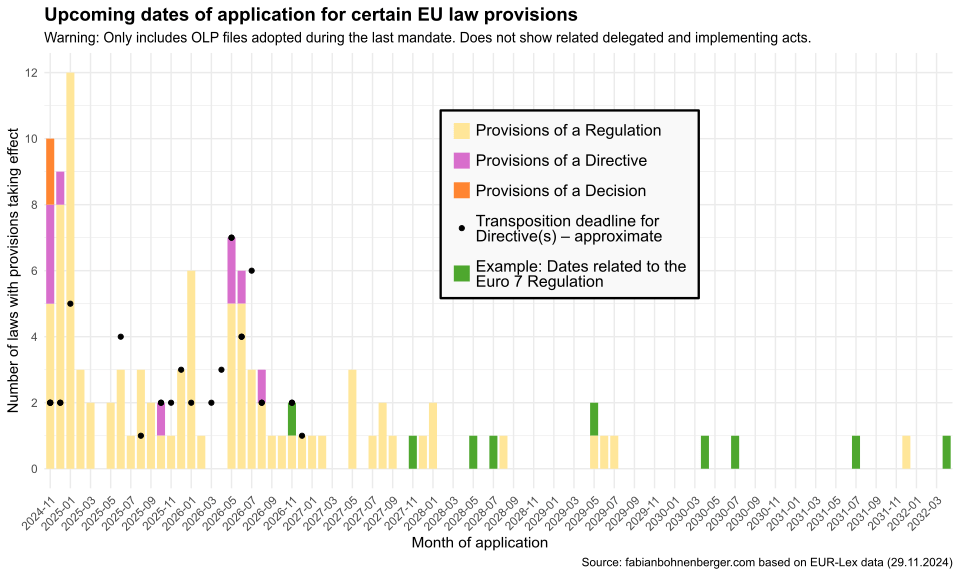
The colours denote different types of EU laws – regulations, directives, and decisions.
In numbers
EUR-Lex lists 109 upcoming dates between November 2024 and April 2032 on which provisions of 69 laws will start to apply (58 regulations, 9 directives, 2 decisions). For example, the General Product Safety Regulation replaces the current General Product Safety Directive on 13 December 2024. (The exact figures will change as more laws are agreed.)
Sometimes multiple laws (or parts of them) start to apply on a specific day. For example, on 1 January 2025, parts of nine laws will take effect and there are three more application dates later in January.
But these numbers underestimate the true implementation challenge – as explained below.
Transposition deadlines
First, as the figure shows, most recorded dates relate to EU regulations. However, there is also a large number of EU directives that will come into play. For these, I have estimated transposition deadlines (the black dots). Transposition is the process by which Member States incorporate EU law into national legislation.
I have identified 50 recently adopted directives that Member States need to transpose over the next two years. (I assume a standard two-year transposition deadline, starting from the law’s entry into force, for all directives.)
The black dots in the figure indicate the month by which Member States must notify transposition of these directives. Reflecting the rush to get laws agreed just before the EU elections earlier this year, there is a corresponding peak of transposition deadlines in mid-2026.
Delegated and implementing acts
Second, and returning to a point made in the previous post, the EUR-Lex data has an important limitation: The EU’s Publication Office only records application dates that are written directly into the law.
This means that EUR-Lex does not include (yet unknown) dates where application timelines depend on future delegated and implementing acts or need to be calculated in other ways.
Let me illustrate.
Examples: Euro 7 vs. Ecodesign
Lawmakers in the Parliament and the Council must choose between setting the application timeline themselves or delegating the details to the Commission. Their approach varies from law to law, which makes it harder to track when each rule actually takes effect.
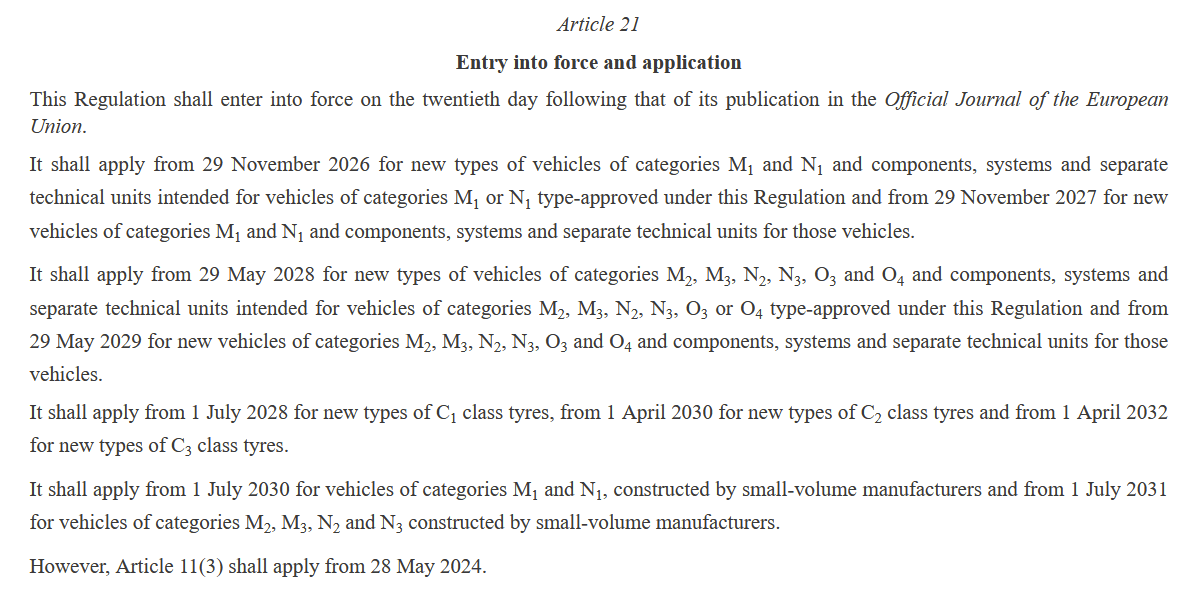
A prime example of the choices involved in designing a law’s application timeline is the Euro 7 Regulation, which aims to reduce motor vehicle emissions.
Unlike many other laws, the regulation includes 10 application dates written directly into the text (see Article 21 below). Such a high level of precision is unusual, especially when it extends so far into the future (the final date is 1 April 2032 – see figure above). This suggests that the Parliament and the Council sought to eliminate any uncertainty about the implementation schedule in this politically sensitive area.
On the other hand, where implementation is left in large part to future actions by the Commission, the EUR-Lex data is much less useful.
For example, the massive implementation effort that will be required to give effect to the Ecodesign Regulation is not reflected in the data – only the date of entry into force is recorded on EUR-Lex.
The regulatory flow burden
This brief review shows that there is a large number of regulatory changes due to take effect over the coming years. It brings us back to the central point: the sheer pace of regulatory change can create costs for affected actors, regardless of how many rules are actively in force at any given time.
Keeping track of the varying application timelines of new EU laws is no small task – and the limitations of the official data only add to the challenge. For instance, the EUR-Lex data I use here does not specify which provisions start to apply at the listed dates. It only tells us that some part(s) of the law take effect. For example, we have to read the European Media Freedom Act to learn that it is Article 3 that started to apply from 8 November 2024 (as stipulated in Article 29).
With a large wave of new laws set to take effect, the burden on Member States, businesses, and others is unlikely to ease. Greater transparency – to say nothing of regulatory simplification – could help reduce this burden. For now, affected actors are left to do much of the heavy lifting themselves.



 Fabian Bohnenberger
4 responses to “How heavy is the EU’s regulatory burden? (Part 2)”
[…] The list is based on EUR-Lex data and focuses on files adopted via the Ordinary Legislative Procedure. This means it is non-exhaustive – there are other application dates that are not included. I explain the data and its limitations here: Part 1 and Part 2. […]
LikeLike
[…] of EU rule changes: lists of future application dates of EU laws – all the way to 2040 (Part 1, Part 2, summary & full […]
LikeLike
[…] means compliance is not a one-off task. It is a moving target and missing a single date can put an entire project or business at risk. I have a solution for […]
LikeLike
[…] Extra: For a deeper discussion of regulatory stock vs. flow (Part 1, Part 2) […]
LikeLike