Keeping track of legislative proposals as they move through the EU system is easier than it looks – here is how you can do it.
Why it matters: Knowing what legislation is being discussed is essential to make your voice heard on issues that affect you. The earlier you can feed in your views, the higher your chances to shape the outcome.
Practical advice: This guide offers a few tips on how to start tracking EU legislation – where to find information, the pros and cons of various data sources, and how to put the pieces together. It mainly applies to proposals moving through the Ordinary Legislative Procedure, not EU law-making in general.

1. Big picture: Let’s start with finding out what laws the Commission is proposing. There are a few key sources that provide an overview of upcoming and pending legislative initiatives:
- The annual Commission Work Programmes (CWP) and annexes list the most important upcoming proposals and pending priority files.
- The Legislative Train Schedule provides a good overview of legislative files across the Commission’s five-year mandate. Unfortunately, and like the CWP, files are grouped not thematically but according to Commission priorities – this takes some getting used to. Information on file progress is updated manually and therefore not always up to date, best to check this elsewhere (see below).
- The Have your Say platform offers advance warning of upcoming initiatives on which the Commission will launch a public consultation. Caution: While this tool allows you to search for initiatives by policy area, the results are not comprehensive. Have Your Say also includes some Commission delegated and implementing acts (I explain what these are here and here) as well as some non-binding acts.
2. Zoom in: You have identified a law you are interested in. The next step is to identify the procedure through which the Parliament and Council will adopt it.
The EU uses various codes to keep track of the process. For example, the CWP provides reference numbers for published proposals:
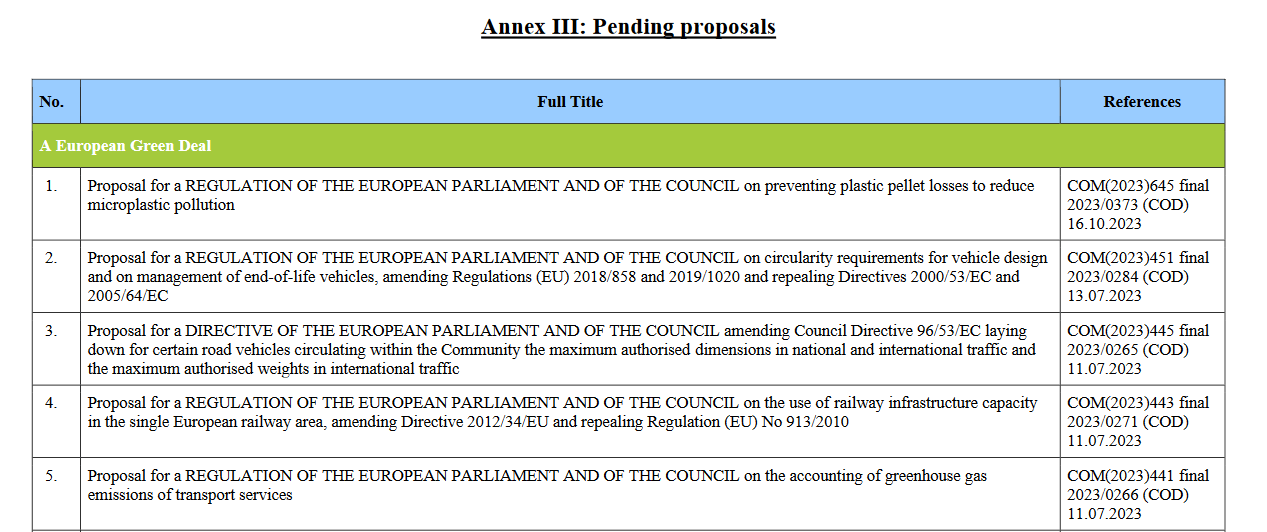
Understanding these references allows you to search for and match information:
- The Commission assigns a unique number to each proposal (and other documents). It follows this standard format: COM(2021)564 final
- The interinstitutional procedure to adopt this proposal also has a unique reference. Example: 2021/0214(COD). COD stands for co-decision/Ordinary Legislative Procedure.
- Once published in the Official Journal, the adopted law receives a final number. Example: REGULATION (EU) 2023/956.
3. Key challenge: Where to find (reliable) information on how close a file is to adoption?
The European Parliament’s Legislative Observatory offers a relatively straightforward way to check legislative progress. Search for the procedure reference or file name and it provides basic information on the file and its status.
However, the Observatory tells Parliament’s side of the story. This means you need a basic understanding of the legislative procedure (and especially how trilogues work) to accurately interpret the information. In particular:
- The Observatory provides data only once the Commission has sent its proposal to Parliament. (For upcoming Commission proposals, go back to Step 1 and see here.)
- The Observatory does not provide information on the Council. For example, it won’t tell you if Member States have agreed their initial position (“general approach”). You can only infer that they have if the responsible parliamentary committee has entered trilogues (“interinstitutional negotiations”).
- While generally accurate, the Observatory is not always up to date – especially after busy plenaries it can take a few days for updates to appear.
- Coding is inconsistent. You will find more information on some procedures than on others. This includes procedure steps.
The procedure reference also allows you to search for Council documents to confirm the existence of a general approach or trilogue agreement, and whether EU Member States have already adopted the law.
4. Go deeper: The databases (even where complete and up to date) won’t tell you what the final law will do and what its prospects for adoption are. Talking to the people involved will get you further. I also explain how to read EU law here.
These documents can also help you deepen your understanding of the proposal and its path to adoption:
- Call for Evidence, Submissions to Public Consultations, Expert Group documents
- Impact Assessment, Regulatory Scrutiny Board opinion, Explanatory Memorandum
- Council Working Party documents, EP committee report and other amendments
Bottom line: Legislative tracking can be learned. This post shows that it is not hard to find basic information on the status of upcoming EU laws.



 Fabian Bohnenberger
2 responses to “How to track EU law”
[…] 🔎 How to track EU law: https://fabianbohnenberger.com/2024/05/20/how-to-track-eu-law/ […]
LikeLike
[…] 🔍 How to track EU law (link) […]
LikeLike