My EU law tracker just received a massive upgrade. I am expanding its scope from around 700 EU laws to more than 60,000 – yes, sixty thousand.
These will first appear in the section showing application dates and compliance deadlines. This means moving from 5–15 legal changes per month to 200–500.
In short: you will get a much more comprehensive view of new legal requirements – and exactly when they take effect.
A tidal wave of legislation
The updated tracker reveals the full scale of the compliance challenge created by the EU’s continuously evolving rulebook.
Take a look: the figure below shows the number of legal changes per month from the year 2000 to 2040. Each bar represents a month.
In this picture you see around 45,000 laws causing over 61,000 changes to the EU rulebook – some laws have multiple application dates for different provisions. (I count all changes equally, irrespective of whether it is a small amendment or major new law starting to apply.)
What stands out is the strong upward trend in the number of provisions that are switched on or off each month over the last decades. More complex EU legislation is one possible explanation, but it may also reflect improved recording of application dates in the EU databases.
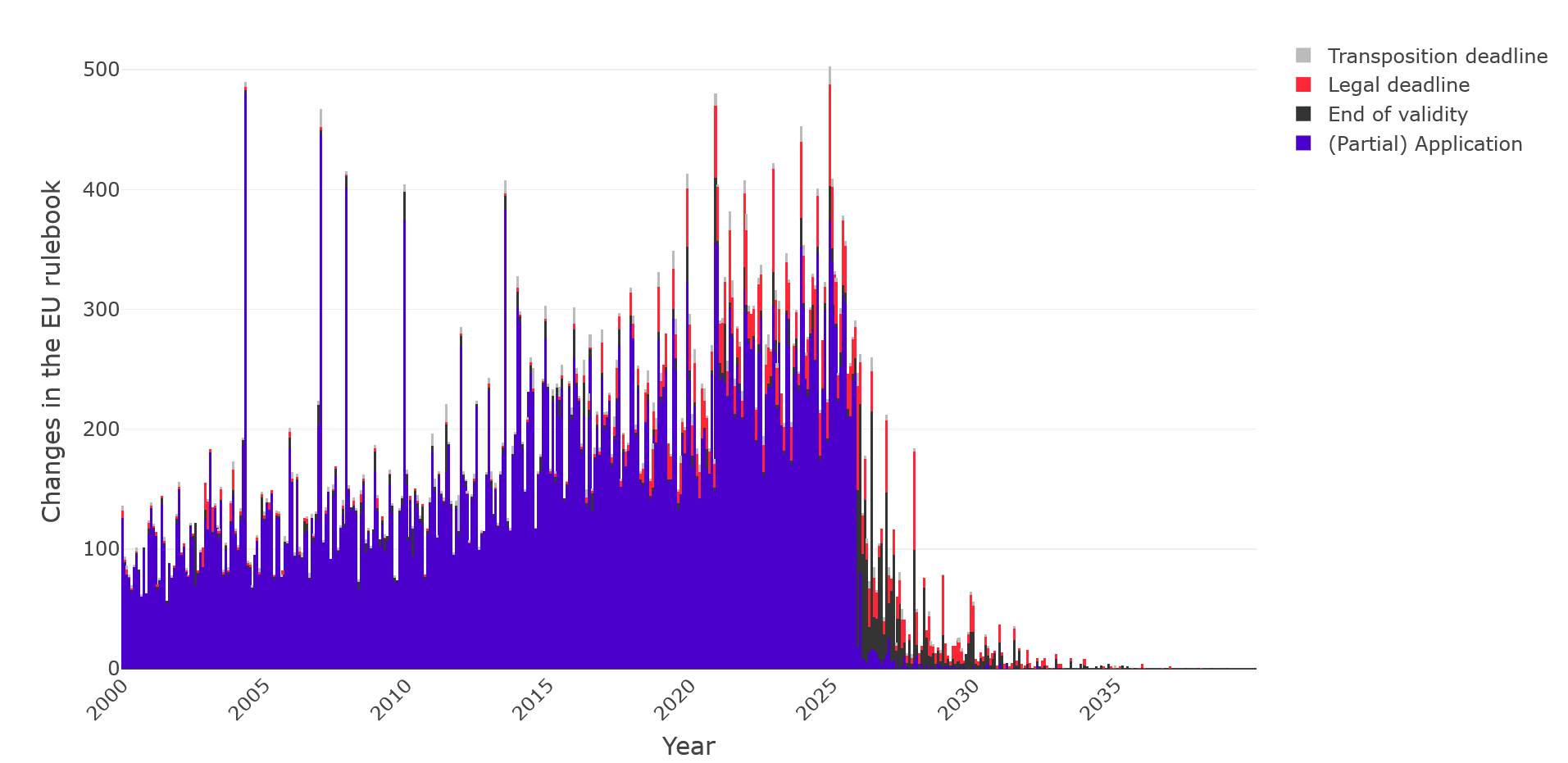
The data is broken down into four categories:
- (Partial) application of new legal requirements
- Legal compliance deadlines set in the law
- Transposition deadlines (dates by which Member States must incorporate EU law into national law)
- End of validity of existing requirements
More detail
Let’s zoom in for a closer look. Here you can see the current segment of the dataset, spanning 2023 to 2027. It already contains around 8,000 laws accounting for close to 13,000 legal changes.
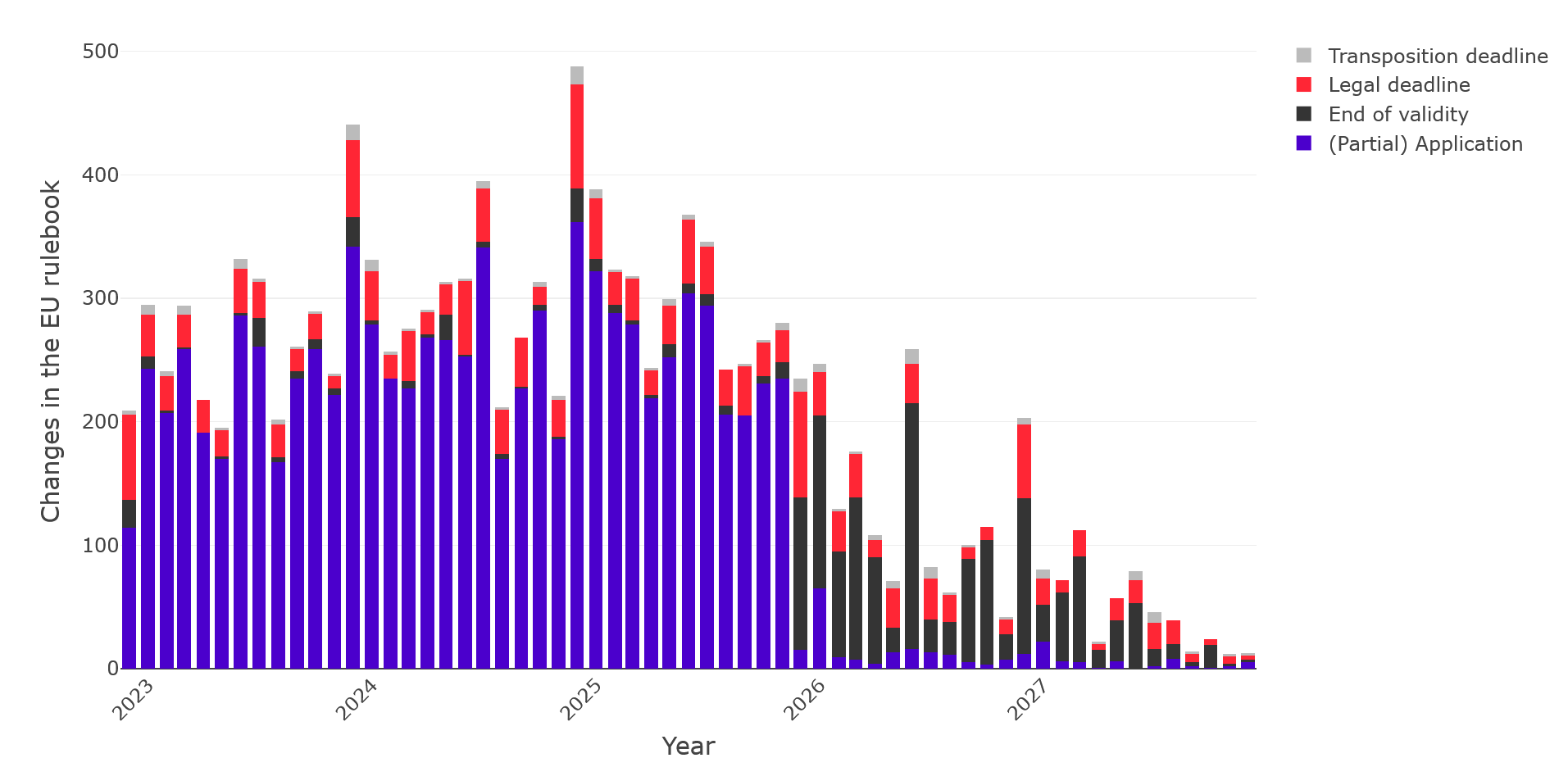
We are currently in November 2025, which explains the sudden drop off. Most legislation begins to apply shortly after it is adopted.
But many laws also extend far into the future: certain requirements like implementation deadlines or reporting obligations only kick in two, five or even ten years later. That long tail is what you see on the right side of the figures – the most distant application date I have is December 2058 (related to the repayment of EU loans).
My tracker maps all these upcoming changes, showing when legal obligations start or cease to apply.
What laws are covered?
The goal is to include all – or, more realistically, most – EU secondary legislation. This means regulations, directives, decisions, implementing and delegated acts as well as other, more obscure legal instruments. If an act carries legal effect, it should appear in the tracker.
For example, the dataset includes around 3,700 legal acts that entered into force in 2024.
What to expect towards the end of 2025?
Looking at the next months, the data reveals an interesting and very human pattern in lawmaking.
December 2025 features 85 legal deadlines, a high number. EU lawmakers, it seems, like using the end of the year as a natural cutoff point. If you look closely, you see this pattern repeat (a large red bar) every December.
By contrast, January 2026 already has a large number (65) of planned application dates. It is intuitively appealing to start new obligations with the new year and, again, the pattern (a large blue bar) repeats at the start of each year.
These expected patterns confirm that the data is relatively comprehensive. Although, with over 60,000 laws in the dataset, there certainly remain some gaps and inconsistencies.
Get ready to explore the data
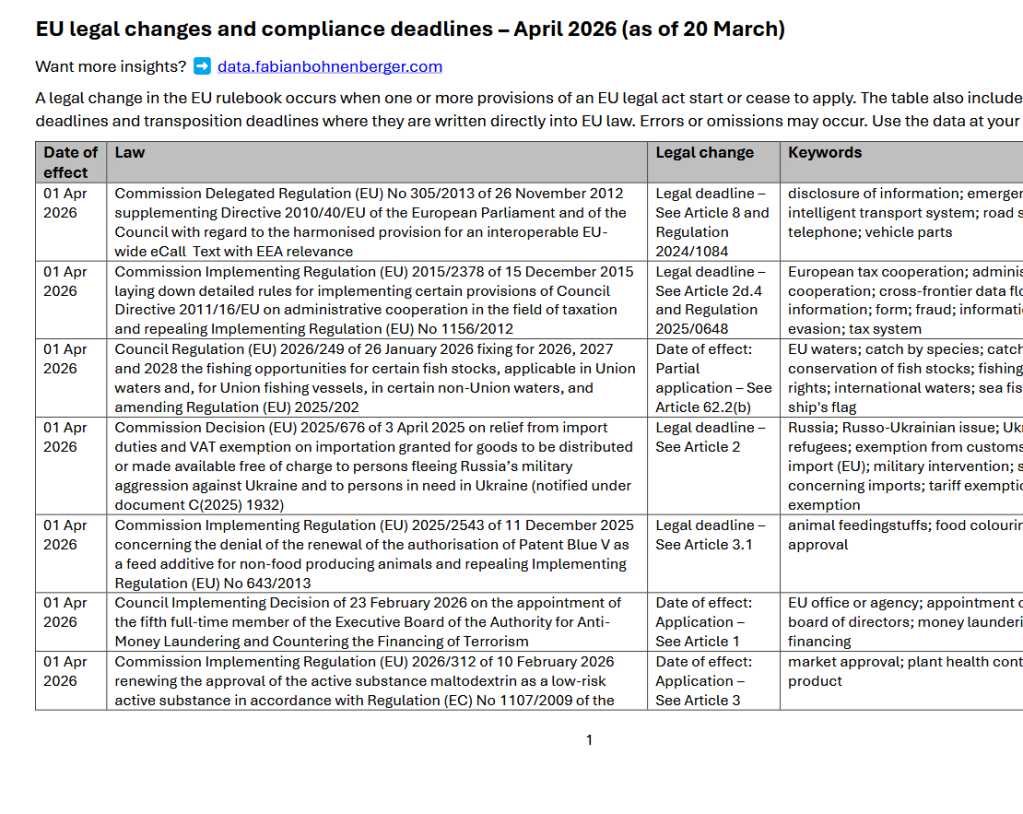
I am currently integrating all this data into the tracker so you’ll be able to explore it yourself. Application dates of major laws adopted since 2019 are already available here.
Because of the large amount of new laws, it is key to ensure that you can filter the data in meaningful ways. No one wants to wade through hundreds of laws each month to find what matters to them.
To make this as useful as possible, your support and ideas are incredibly valuable. Please share the tracker and let me know what you think.
Extra: For a deeper discussion of regulatory stock vs. flow (Part 1, Part 2)

 Fabian Bohnenberger
One response to “Tracking EU law at scale: 60,000+ laws and counting”
[…] January is usually a particularly busy month. The turn of the year is a natural moment for provisions to start or stop applying. That said, a few hundred legal changes per month is not unusual in the EU system. See the figure below, where I plot legal changes per month. I explain this dynamic in more detail here. […]
LikeLike