The European Parliament’s process for adopting its negotiating position for interinstitutional negotiations (trilogues) can be hard to understand. A frequent source of confusion is that there are two different ways in which Parliament can enter into trilogues ahead of its 1st reading: on the basis of a so-called “committee mandate” or a “plenary mandate”.
1. Committee mandate
Once a parliamentary committee adopts its report on a legislative proposal, it can decide (by a majority of its members) to enter into trilogue negotiations on the basis of that report. This decision is announced at the next plenary session and can be subject to a vote if enough MEPs request it (see Rule 72 of Parliament’s Rules of Procedure).
If Parliament does not reject the committee’s decision, trilogue negotiations can proceed based on the legislative report adopted in the committee. This is a so-called “committee mandate”.
2. Plenary mandate
Alternatively, the committee can decide to submit its report to the plenary for a vote. The committee might also be required to do so because plenary rejected the committees decision to enter into trilogue negotiations (see above).
Once Parliament has voted on the draft legislative act and (amended) committee report, it can decide to refer the matter back to the committee responsible for trilogue negotiations (see Rule 60(4) RoP). The committee can then enter into trilogues on the basis of a “plenary mandate”.
If the matter is referred back to committee, the Parliament is not concluding its 1st reading but delaying its decision to allow time for interinstitutional negotiations.
How does it work
The Parliament’s old procedure handbooks include a good flowchart of the decision making process. There have been some changes (for example, Rule 59 cited below is now Rule 60), but the figure remains useful.
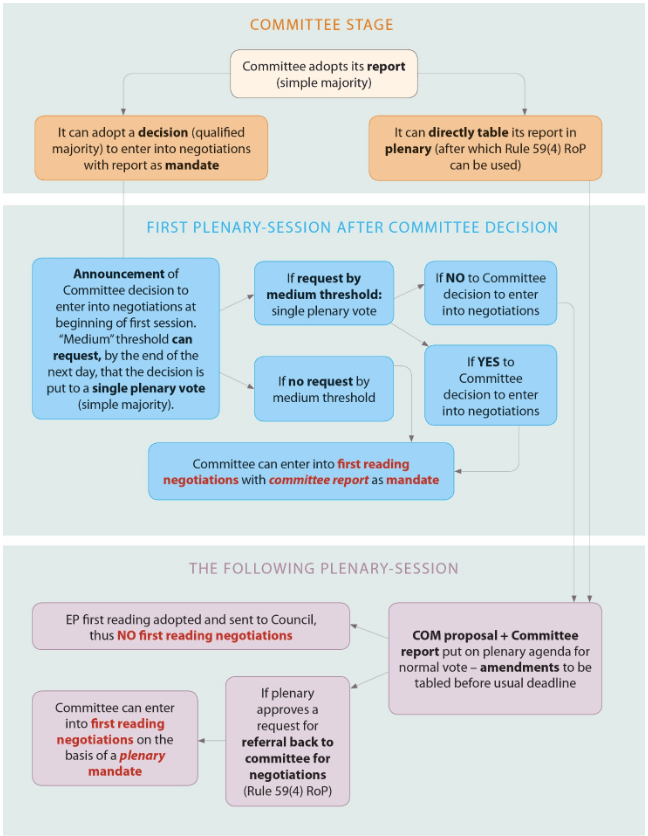
Source: EP procedure handbook
How to spot the difference
Here is a side-by-side comparison of the two procedures based on data from the Legislative Observatory. Note that these examples use the old Rules of Procedure that applied during the last mandate. Rule 71 (cited here) now corresponds, with minor modifications, to Rule 72.
| Committee mandate | Plenary mandate |
| e.g. 2022/0032(COD), 2022/0068(COD) | e.g. 2022/0278(COD), 2022/0047(COD) |
| Legislative proposal published | Legislative proposal published |
| Committee referral announced in Parliament, 1st reading | Committee referral announced in Parliament, 1st reading |
| Referral to associated committees announced in Parliament | Referral to associated committees announced in Parliament |
| Referral to joint committee announced in Parliament | – |
| Vote in committee, 1st reading | Vote in committee, 1st reading |
| Committee decision to open interinstitutional negotiations with report adopted in committee | – |
| Committee report tabled for plenary, 1st reading | Committee report tabled for plenary, 1st reading |
| Committee decision to enter into interinstitutional negotiations announced in plenary (Rule 71) | – |
| Committee decision to enter into interinstitutional negotiations confirmed by plenary (Rule 71) | – |
| – | Debate in Parliament |
| – | Decision by Parliament, 1st reading |
| – | Results of vote in Parliament |
| – | Matter referred back to the committee responsible for interinstitutional negotiations |
| Approval in committee of the text agreed at 1st reading interinstitutional negotiations | Approval in committee of the text agreed at 1st reading interinstitutional negotiations |
| Decision by Parliament, 1st reading | Decision by Parliament, 1st reading |
| Results of vote in Parliament | Results of vote in Parliament |
| Debate in Parliament | – |
| Act adopted by Council after Parliament’s 1st reading | Act adopted by Council after Parliament’s 1st reading |
| Final act signed | Final act signed |
| Final act published in Official Journal | Final act published in Official Journal |
Picture credit: CC-BY-4.0: © European Union 2025– Source: EP

 Fabian Bohnenberger
One response to “How the European Parliament adopts a mandate for trilogues”
[…] 🏛️ How the European Parliament adopts a mandate for trilogues (link) […]
LikeLike