If you want to have a voice in shaping EU policy, it’s crucial to stay on top of the legislative process. The European Parliament’s Legislative Observatory is a key tool for doing that.
But the way the Observatory presents information doesn’t make it easy.
Take the “Status” indicator at the top of each page. It’s meant to show the progress of a legislative file—but it doesn’t quite do that. Rather than describing the most recent development, it indicates the next major step in the process (“awaiting …”), which can be confusing if you want to understand where things currently stand.
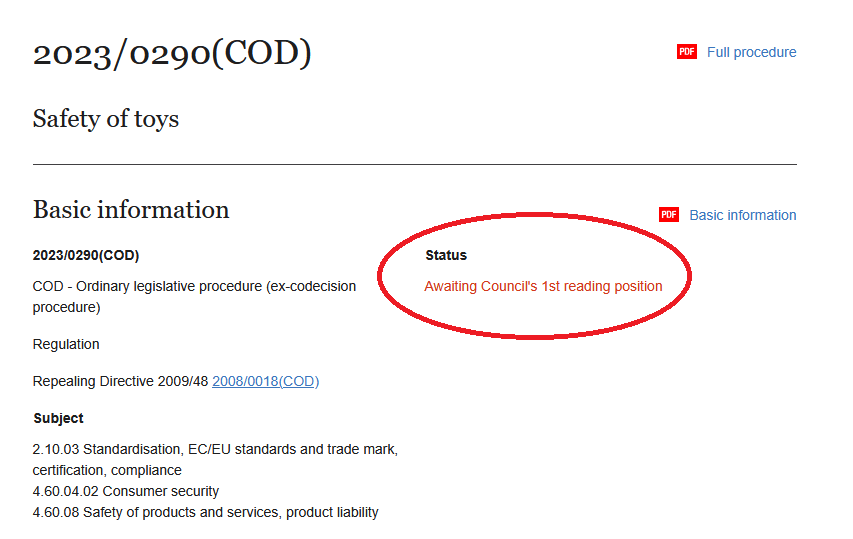
One of the biggest gaps in the Status indicator is around trilogues—the informal interinstitutional negotiations that often shape the final outcome of EU legislation. Despite their importance, the Status does not reflect when trilogues are happening. In fact, the indicator won’t update at all until the European Parliament has formally adopted its 1st reading position.
This creates a major blind spot. The institutions can be deep into negotiations, yet the process seems to be standing still, “Awaiting Parliament’s position in 1st reading.” The only exception is when trilogues happen after Parliament has adopted its position at 1st reading (see Rule 72 of the old Rules of Procedure/Rule 73 in the new RoP). But even then, the Status won’t mention trilogues directly and jump straight to “Awaiting Council’s 1st reading position.”
Be mindful of this gap because it can create a false sense of inactivity at one of the most critical stages of the process.
Legislative Process according to the Observatory
To be fair, the Legislative Observatory does provide more detailed process information further down the page, in a table titled “Key events.” This is where you can find a chronological list of actions taken on a legislative file—committee referrals, decisions, votes, and more.
However, it’s surprisingly difficult to tell how this list connects to the Status indicator shown at the top. The correlation isn’t always clear, partly because the procedural steps vary depending on the specific path each file takes.
Here is a summary of how “Status” aligns—or not—with the most recent step recorded in the “Key events” table. (Based on the data of the 185 Ordinary Legislative Procedure (OLP) files that reached Parliament between January 2023 and now.)
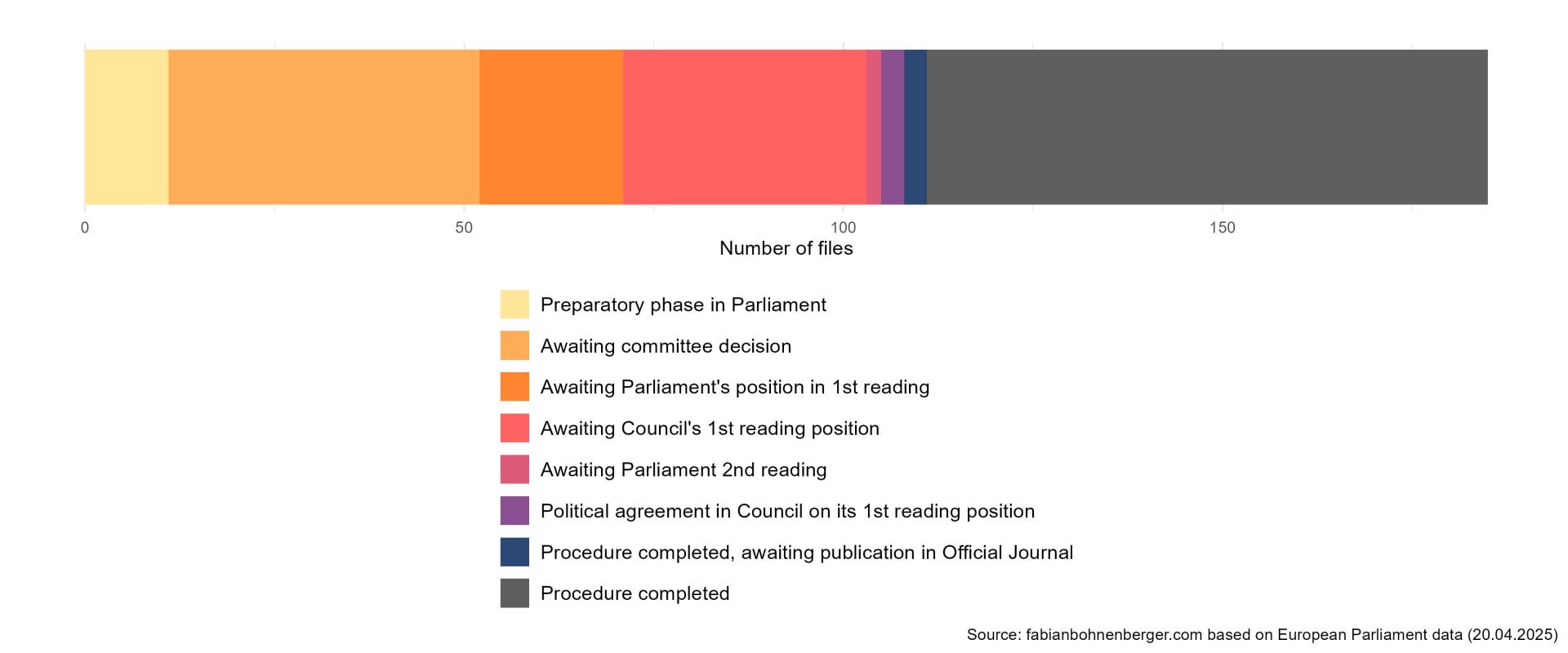
You can see that the Status indicator uses at least eight values, from “Preparatory phase in Parliament” to “Procedure completed.” (Confusingly, these two values refer to the current stage, while the others point to the next step.) These correspond to over 16 different steps logged under key events—I’m omitting some of the more confusing ones.
| Status | Most recent “Key event” |
| Preparatory phase in Parliament | Legislative proposal published |
| Awaiting committee decision | Committee referral announced in Parliament, 1st reading |
| Awaiting committee decision | Referral to joint committee announced in Parliament |
| Awaiting Parliament’s position in 1st reading | Committee referral announced in Parliament, 1st reading |
| Awaiting Parliament’s position in 1st reading | Committee decision to enter into interinstitutional negotiations confirmed by plenary (Rule 71) |
| Awaiting Parliament’s position in 1st reading | Committee decision to enter into interinstitutional negotiations confirmed by plenary (Rule 71 – vote) |
| Awaiting Parliament’s position in 1st reading | Decision by Parliament, 1st reading |
| Awaiting Parliament’s position in 1st reading | Matter referred back to the committee responsible for interinstitutional negotiations |
| Awaiting Parliament’s position in 1st reading | Committee report tabled for plenary, 1st reading |
| Awaiting Council’s 1st reading position | Committee decision to enter into interinstitutional negotiations announced in plenary (Rule 72) |
| Awaiting Council’s 1st reading position | Committee referral announced in Parliament, 1st reading |
| Awaiting Council’s 1st reading position | Committee decision to open interinstitutional negotiations after 1st reading in Parliament |
| Awaiting Parliament 2nd reading | Committee recommendation tabled for plenary, 2nd reading |
| Political agreement in Council on its 1st reading position | Approval in committee of the text agreed at early 2nd reading interinstitutional negotiations |
| Political agreement in Council on its 1st reading position | Committee decision to enter into interinstitutional negotiations announced in plenary (Rule 72) |
| Procedure completed, awaiting publication in Official Journal | Final act signed |
| Procedure completed, awaiting publication in Official Journal | Act adopted by Council after Parliament’s 1st reading |
| Procedure completed | Final act published in Official Journal |
| Procedure completed | Final act signed |
Notice that “Awaiting Parliament’s position in 1st reading” is so broad that it covers most of the process for most files—including trilogues—making it hard to tell what’s actually happening.
Here is a breakdown of the current status of the 185 files in my sample—the distribution is unusual because we are still early in the current mandate. Before the last EU elections, Parliament adopted many 1st reading positions to preserve progress made on certain files. This explains the large group of files now labelled as “Awaiting Council’s 1st reading position”. (And, unfortunately, the Observatory is not always up to date on Council positions.)
There is one special case where the forward-looking nature of the Status indicator is genuinely useful. After the European elections, some legislative files need to repeat certain administrative steps in the new Parliament (like being reassigned to a committee) before work can resume. In these cases, the Status indicator helps keep the focus on the next key step—this explains why there are a few correlations of “Awaiting Council’s 1st reading position” with “Committee referral announced in Parliament, 1st reading” in the table above. (For example, see 2023/0055(COD) or 2023/0290(COD).)
In short, be very careful how you use EU legislative data and what you infer from it about the process and status of upcoming laws. The Observatory is intended to offer clarity, but can easily mislead. Successfully navigating EU law-making still requires a good deal of process knowledge. A more intuitive and transparent presentation of the data would make the system far more accessible to those trying to follow or work with EU law.

 Fabian Bohnenberger
2 responses to “Lost in Legislation: Navigating the European Parliament’s Observatory”
[…] explain the process stages – denoted by the colours – here. (There is scope for improvement because this official classification is not easy to […]
LikeLike
[…] 🛰️ Lost in legislation: Navigating the European Parliament’s Observatory (link) […]
LikeLike