Confused about the new EU jargon on simplification? Can’t tell a stress test from an implementation dialogue or an omnibus package? You are not alone.
Over the past few weeks, the European Commission has unveiled a set of shiny new tools to cut regulatory burdens and streamline the EU rulebook. But with so many overlapping announcements, keeping up can be a challenge.
Here is an overview of the Commission’s new and revised simplification toolkit:
Omnibus packages
The Commission has announced a series of (“at least five”) omnibus simplification proposals that will address interactions between existing laws:
- The first omnibus package will be published on 26 February and focuses on sustainable finance reporting, sustainable due diligence and taxonomy.
- The second proposal, announced for Q1 2025, will focus on investment simplification by facilitating the deployment of InvestEU and the European Fund for Strategic Investments and simplifying reporting.
- The third omnibus, announced for Q2 2025, will aim to ensure that small mid-cap companies “have adapted requirements” and remove “inefficient requests for paper format in product legislation.”
- A digital simplification package, including on cybersecurity (Q4 2025)
- Simplification of the Common Agricultural Policy for farmers.
The Commission has hinted at further omnibus packages, e.g., for defence to help reach the investment goals that will be set out in the upcoming White Paper.
Implementation dialogues
Each Commissioner is now required to hold at least two implementation dialogues per year with stakeholders to discuss how to best align implementation with realities on the ground.
Reality checks
At the technical level, the Commission commits to “reach out to practitioners in companies, in particular SMEs and small mid-caps across a wide range of areas.” These reality checks are meant to identify practical hurdles (e.g. related to authorisations, permitting, control or compliance).
The findings will feed into the stress-testing of existing legislation (including evaluations and fitness checks) and the design of future simplification proposals.
Stress-testing
Stress-testing will be a continuous process, with the aim to “review the entire EU acquis [i.e., the EU rulebook] to capture its cumulative impacts, potential inconsistencies and simplify it”.
The Commission pledges that “concrete simplification measures will be included in the Commission work programme each year.” The Commissioner for Implementation and Simplification will oversee the coordination of these tasks and ensure that they are conducted coherently across the Commission.
Evaluations & fitness checks
Evaluations of individual laws and fitness checks of whole policy areas remain the key tools to review (and “stress-test”) existing legislation. The results will feed into the next round of simplification packages.
The Commission Work Programme lists upcoming evaluations and fitness checks. For example, the “Fitness check on the legislative acquis in the digital policy area” (to be finalised in Q4 2025), will feed into the also announced “Digital package” (legislative, incl. impact assessment, Q4 2025).
Annual reports on enforcement and implementation
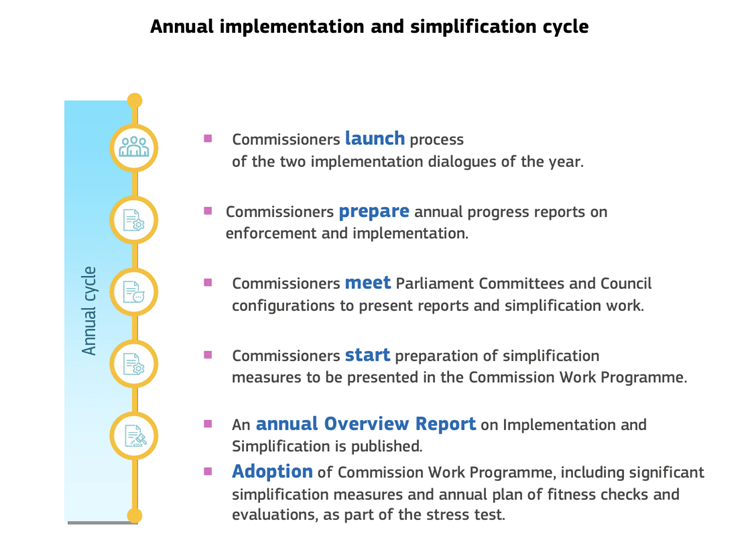
Building on the implementation dialogues, each Commissioner is now required to present an annual progress report on enforcement and implementation to their respective European Parliament committee(s) and Council formation(s).
The report should present progress on key policy objectives and “identify issues of poor implementation, gold plating, over-compliance or fragmentation, and uncover opportunities for simplification and harmonisation.”
The Commission will also present an overview report for the annual implementation and simplification cycle.
Annual implementation and simplification cycle
The Simplification communication outlines an annual cycle for simplification, which ties together some of the elements explained above:
SME and competitiveness tests
The Commission’s revised Working Methods require legislative drafts to undergo stricter SME and competitiveness checks in the impact assessment.
On competitiveness, the Commission pledges to pay more attention to the competitive position of EU companies affected by new legislation, also compared to international competitors.
On SMEs, impact assessments will present more clearly the impacts on SMEs, as well as supportive and mitigating measures.
Digital-ready policies
The Commission commits to further embed the “digital by default” and “once-only” principles and to use tools like regulatory sandboxes, advance the interoperability of public administrations, extend the use of e-platforms, and the re-use of existing data.
The Commission has developed a new “Legislative, Financial and Digital Statement” to accompany its proposals, which will include information on the digital aspects of proposals and serve as the Commission’s interoperability assessment report (as mandated by the Interoperable Europe Act).
Dynamic impact assessments
The Commission has called on the European Parliament and the Council to put in place a process to assess the impact of substantial legislative amendments.
In Q2 2025, the Commission will put forward suggestions to the co-legislators on a simple methodology for assessing the impacts of amendments.
Implementation strategies and transposition roadmaps
The Commission committed to systematically prepare implementation strategies for major legislative acts to identify legal, administrative and practical challenges tor transposing and applying the legal act. These will also specify monitoring arrangements, timelines and support for Member States through the implementation process.
For directives, the Commission suggests explanatory templates and transposition roadmaps to support faster and full transposition.

 Fabian Bohnenberger
One response to “Understanding the EU’s New Simplification Toolkit”
[…] 🧰 Understanding the EU’s new simplification toolkit (link) […]
LikeLike