Amid growing concerns over EU competitiveness, Brussels is intensifying efforts to cut red tape. Commission President von der Leyen has appointed a new “Commissioner for Implementation and Simplification” and tasked her new team with reducing reporting obligations for businesses by at least 25 percent. Last week, EU leaders went further, calling for nothing less than a “simplification revolution”.
But how big is the challenge? Despite many warnings about the EU’s aggregate regulatory burden, concrete data on its scale remains scarce. As the Draghi report notes, attempts to measure the total regulatory burden are “hindered by differing or piecemeal approaches” (p. 317).
Measuring the burden is complex, but let’s begin. This post introduces key concepts to help you understand the simplification challenge and starts to explore how many EU rules took effect during the last mandate.
The answer to this seemingly simple question isn’t straightforward. Between November 2019 and October 2024, many laws were adopted, but not all have started to apply. In addition, some are technical updates to existing legislation, which may not introduce entirely new requirements but still influence the overall regulatory burden – positively or negatively.
Regulatory stock vs. flow
When considering the regulatory burden, it is important to account for both the number of existing legal requirements (the “regulatory stock”) and how frequently new rules are introduced or updated (the “regulatory flow”).
Both can pose challenges for the citizens, businesses, Member States, and others who must comply with the EU rules.
To better understand how the regulatory flow impacts these groups, let’s use a simplified example. We’ll focus on Ordinary Legislative Procedure (OLP) files that started to apply – at least in part – during the last mandate. As we’ll see, there is a significant number of them (342). However, there are even more application dates, illustrating the complexity of implementing EU legislation.
| Number of laws (OLP) | Number of application dates | |
| Regulation | 244 | 387 |
| Directive | 64 | 72 |
| Decision | 34 | 42 |
| TOTAL | 342 | 503 |
Note: Files with date(s) of application between 01 Nov 2019 and 31 Oct 2024. Excluding 22 incorrectly dated entries.
The discrepancy between the number of laws and number of application dates is due to phased application – when different provisions of a law take effect at different times. Some laws have multiple dates of application (up to 10). This staggered approach allows industry, Member States, and other affected parties to gradually adapt to new regulations.
While the phases ease the transition, they also add complexity. Each phase introduces new obligations, layering the administrative burden over time.
Phased application complicates efforts to measure the regulatory burden. Should we evaluate it based on the provisions currently in effect, or consider the full scope of rules that will eventually apply once all changes are implemented?
Example vs. real world
But we’re still only considering a simple example of the regulatory burden.
The EU Publications Office, which helpfully provides the application dates I use above, takes a conservative approach when recording these dates. This means that the true complexity of implementation timelines – and the regulatory flow – is greater than the table above suggests.
Here’s why: The data I use only includes dates that are explicitly specified in the law. For example, if a law states that “Articles 5, 10, 14, 16, and 17 shall apply from 31 December 2024” – as in Article 36(2)(a) of the CBAM Regulation – this date would be recorded.
By contrast, when implementation timelines depend on future delegated and implementing acts, EUR-Lex does not capture these (yet unknown) dates. This means, for example, that the massive implementation effort that will be required for the Ecodesign Regulation is not reflected; EUR-Lex records only the date at which the main regulation entered into force.
Hundreds of these implementing and delegated acts will be necessary over the coming years to give effect to the requirements laid down in the OLP files mentioned above.
Flow of EU legislation
But even with these limitations, the Publications Office’s count reveals the steady drumbeat of new EU rules. Focusing only on OLP files, a fraction of EU law, we can still see how many major EU laws have taken effect in recent years.
The data averages at around 8.8 application dates per month (or 6 OLP laws per month) over the last mandate, which seems like a lot of regulatory change if you’re not equipped for it – although, of course, few actors (mainly Member States governments) will be affected by all of it. Let’s not dwell on the scary peaks in the figure below.
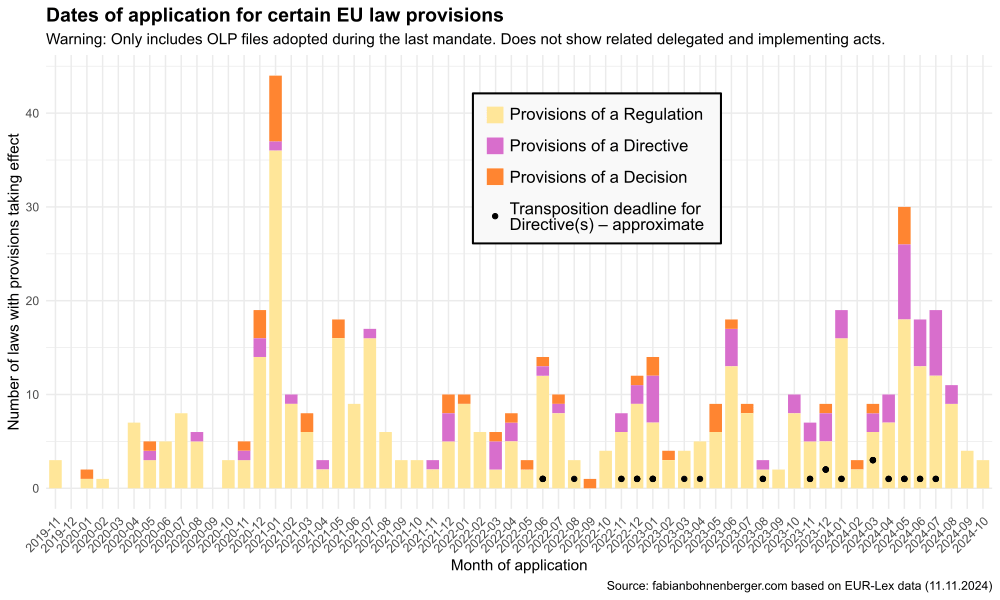
The colours denote different types of EU laws – regulations, directives, and decisions.
I have also estimated transposition deadlines for directives (the black dots). Transposition is the process where Member States incorporate EU law into national law, which is mostly relevant for directives. Transposition becomes more relevant in the next post, which explores future dates.
Looking ahead: Tackling Regulatory Complexity
This analysis shows that regulatory burden depends not just on the total number of existing rules (“regulatory stock”), but also on how frequently new rules take effect (“regulatory flow”).
While many criticise the sheer volume of requirements, the Draghi report also pays attention to the complexity added by frequent legislative changes, complex implementation, and transposition. Draghi warns that higher regulatory flow “is among the factors making the EU’s regulatory environment less favourable for conducting business compared to the US” (p. 318).
According to his rough estimate, the EU adopted around 13000 legal acts during the last mandate, plus national laws by Member States. My analysis covered only a fraction, but it illustrates the regulatory flow challenge.
In the next post, I’ll explore upcoming application dates through 2032 and the rising number of transposition deadlines.

 Fabian Bohnenberger
4 responses to “How heavy is the EU’s regulatory burden? (Part 1)”
[…] on my previous analysis of the EU regulatory burden, this post takes a forward look at upcoming application dates. My focus […]
LikeLike
[…] are other application dates that are not included. I explain the data and its limitations here: Part 1 and Part […]
LikeLike
[…] ahead of EU rule changes: lists of future application dates of EU laws – all the way to 2040 (Part 1, Part 2, summary & full […]
LikeLike
[…] For a deeper discussion of regulatory stock vs. flow (Part 1, Part […]
LikeLike