Some of you have asked for further explanation of our detailed flowchart on the EU law-making process, so here it is: a concise narrated guide. I’ll highlight some of the key activities, which will help you navigate the extensive chart with its over 120 steps.
First, let me introduce the star of the show: the CLP Regulation, which we used as our case study. Officially known as the Regulation on Classification, Labelling, and Packaging of Substances and Mixtures (Regulation (EC) No 1272/2008), the CLP Regulation is a cornerstone of the EU’s framework for chemicals safety.
Originally adopted in 2008, the CLP Regulation has undergone a significant revision over the last mandate, which we have analysed and visualised in our flowchart.
Here is the simplified version showing the sequence of events that I’ll discuss below:
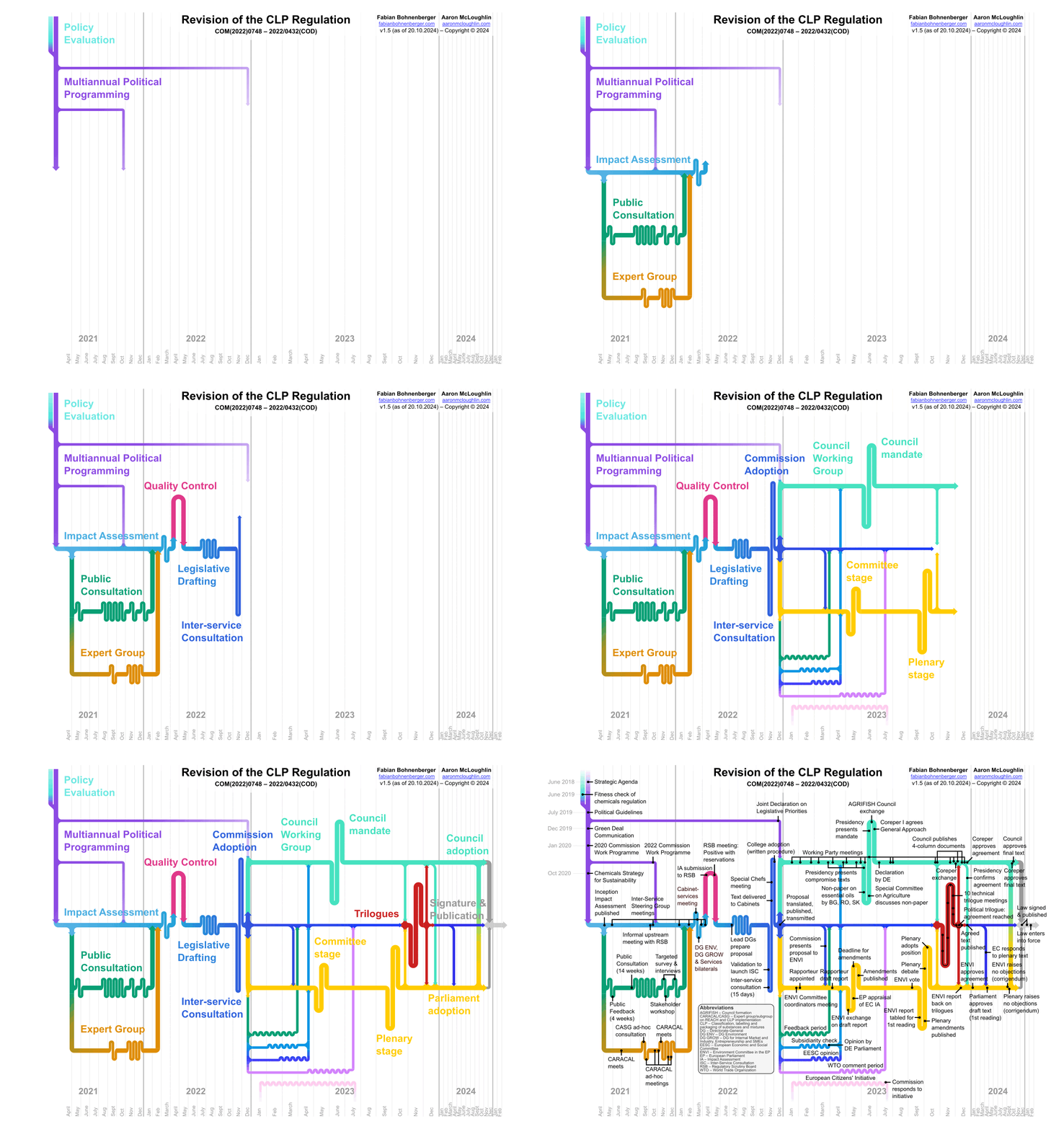
Let’s consider the key steps in the law-making process:
1. Evaluation
The Commission evaluated the effectiveness of the existing CLP Regulation (and other chemical legislation) in 2019 in what is know as a “fitness check”. This assessment identified some shortcomings of the law and its implementation, which provided the motivation for the revision.
2. Political Programming
In 2019, Commission President von der Leyen’s European Green Deal strategy offers the political momentum to enhance EU chemicals legislation. In her Political Guidelines, she states:
“Europe needs to move towards a zero-pollution ambition. I will put forward a cross-cutting strategy to protect citizens’ health from environmental degradation and pollution, addressing air and water quality, hazardous chemicals, industrial emissions, pesticides and endocrine disrupters.” (p. 7)
Accordingly, the 2020 Commission Work Programme announces a Chemicals Strategy for Sustainability, which in turn outlines plans for the revision of the CLP Regulation a few months later.
3. Impact Assessment
Following this legislative planning, relevant Commission departments (DG ENV and DG GROW) start more detailed work on a full Impact Assessment on how best to address the shortcomings of the existing law. To coordinate this work, they form an Inter-Service Steering Group.
In early May 2021, the responsible Commission services publish a so-called Inception Impact Assessment. This is a short document that outlines the Commission’s plans and asks citizens and affected stakeholders to provide their views.
A reminder from an attentive reader: The public consultation process has slightly changed since the CLP Regulation passed this stage. The Inception Impact Assessment is now known as a “Call for Evidence”.
4. Public Consultation
Starting with the Inception Impact Assessment, the Commission conducts a series of public feedback rounds, including a 14-week consultation from August to November 2021 to gather evidence from affected stakeholders. The Commission also organises a series of interviews and workshops.
5. Expert Group
In parallel, the Commission uses expert groups to consult Member States’ specialists, business associations and civil society organisations. The main expert group for CLP is known as CARACAL – it’s official title does not exactly roll off the tongue: Competent Authorities for Registration, Evaluation, Authorisation and restriction of Chemicals (REACH) and Classification, Labelling and Packaging (CLP).
CARACAL and its subgroups hold various meetings in 2021 to discuss different elements of the CLP revision, which provides the Commission with valuable expert input.
6. Quality Control
The Commission services submit the Impact Assessment to the Commission’s internal Regulatory Scrutiny Board for quality assurance.
The Regulatory Scrutiny Board approves the plans, but asks for some improvements to be made.
7. Legislative Drafting
Between May and October 2022, DG ENV and DG GROW prepare the actual legislative proposal.
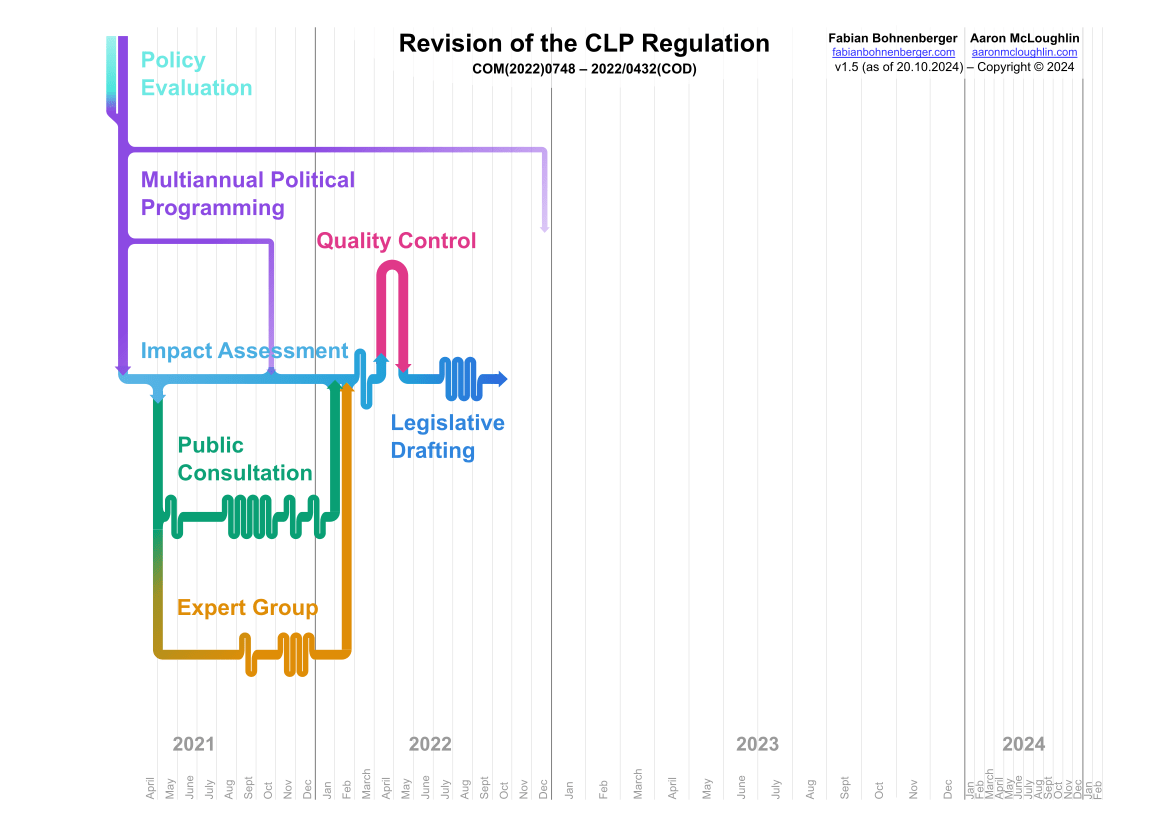
8. Inter-service Consultation
In November 2022, the legislative proposal moves through Inter-service Consultations. This means all relevant Commission services have an opportunity to issue a formal opinion on the legislative draft. The text is also sent to Commissioners’ cabinets for review.
9. Commission adopts proposal
Following the Inter-service Consultation and meetings between cabinets, the College of Commissioners formally adopts the legislative proposal in December 2022. (In this case, via written procedure.)
After adoption by the College, the proposal is finally published and sent to the European Parliament, the Council, national parliaments and others actors.
It is important to pause here and remember that only now does the Commission-internal part of law-making end and the Ordinary Legislative Procedure begin. At this point, the process splits into two main strands – one for each co-legislator: the European Parliament and the Council.
10. Parliament: Committee stage
Parliament assigns responsibility for the CLP revision to the Committee on the Environment, Public Health and Food Safety, which in turn designates some of its members to start work on the file. Coordinating with her colleagues across political groups, the rapporteur Maria Spyraki drafts a report that outlines Parliament’s position on the proposed law.
The committee then debates, amends and votes on the report on 11 September 2023.
11. Parliament: Plenary stage
On 3 October 2023, Parliament holds a plenary debate on the committee report and further amendments, followed by a sequence of votes on the next day.
With 519 in favour, 99 against and 8 abstentions, Parliament adopts its position on the Commission proposal. It also decides to refer the file back to the responsible committee for interinstitutional negotiations (trilogues).
12. Council: Working Party
In parallel, Member State representatives discuss the draft law and negotiate what a compromise could look like from their perspective. This primarily happens in the relevant Council body, the Working Party on Technical Harmonisation (Dangerous Substances – Chemicals).
The rotating Council Presidency (first Sweden, then Spain) manages this negotiation process among the Member States, including by scheduling meetings and proposing compromise texts.
13. Council: General Approach
Negotiations come to a head in June 2023. Member State representatives have agreed most of their position, but tensions remain on a few issues.
One disagreement concerns how essential oils, used in a wide range of products from perfumes to food, are classified for certain hazards – this explains the curious step titled “non-paper on essential oils” in our flowchart.
The lobbying of some Member States including Bulgaria, Romania and Slovakia, who submitted the paper to their colleagues, is successful. On 30 June 2023, the Council agrees its negotiation mandate, called a General Approach, which aims to delete provisions related to multi-constituent substances (which covers essential oils) from the Commission proposal.
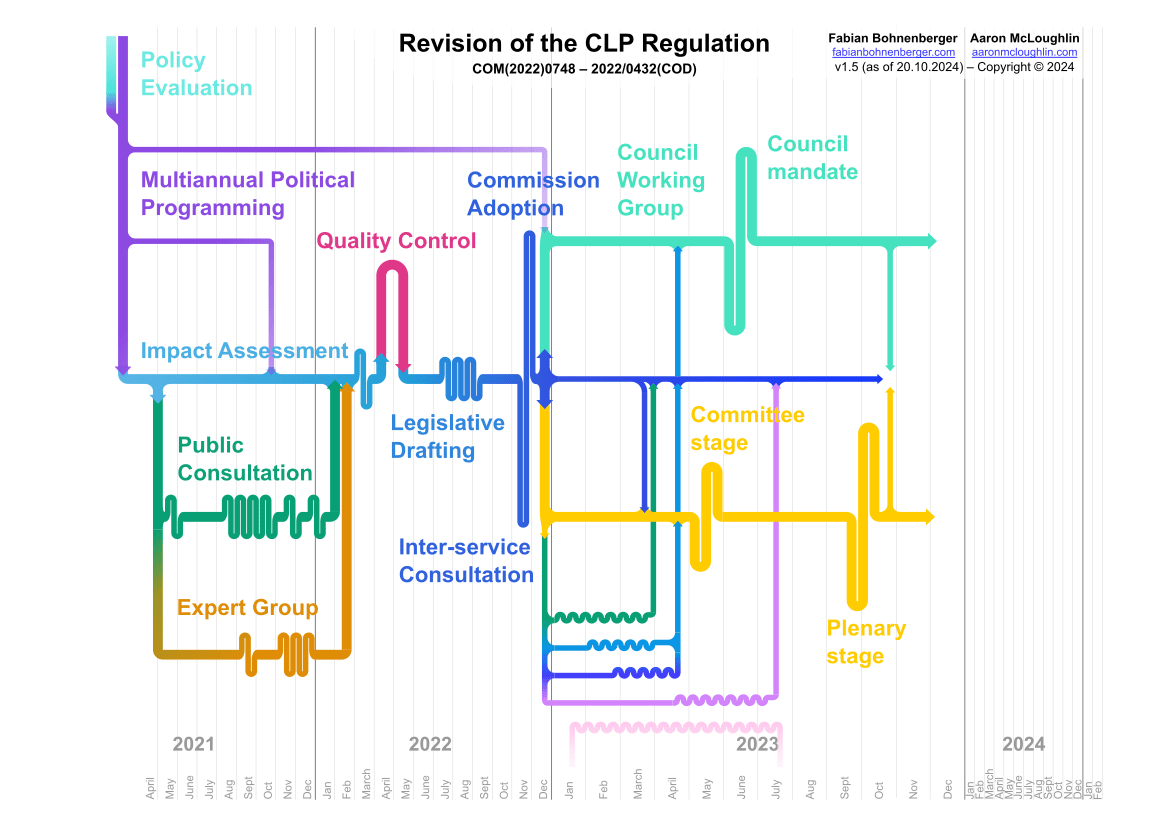
14. Trilogues
With Parliament and Council positions agreed, negotiators move into trilogues. The institutions hold ten technical trilogue sessions, culminating in political agreement on 5 December 2023.
One outcome is the decision to modify the Commission’s proposal by exempting substances with multiple constituents that are extracted from plants or plant parts. Instead, Parliament and Council ask that the Commission review the issue in the future.
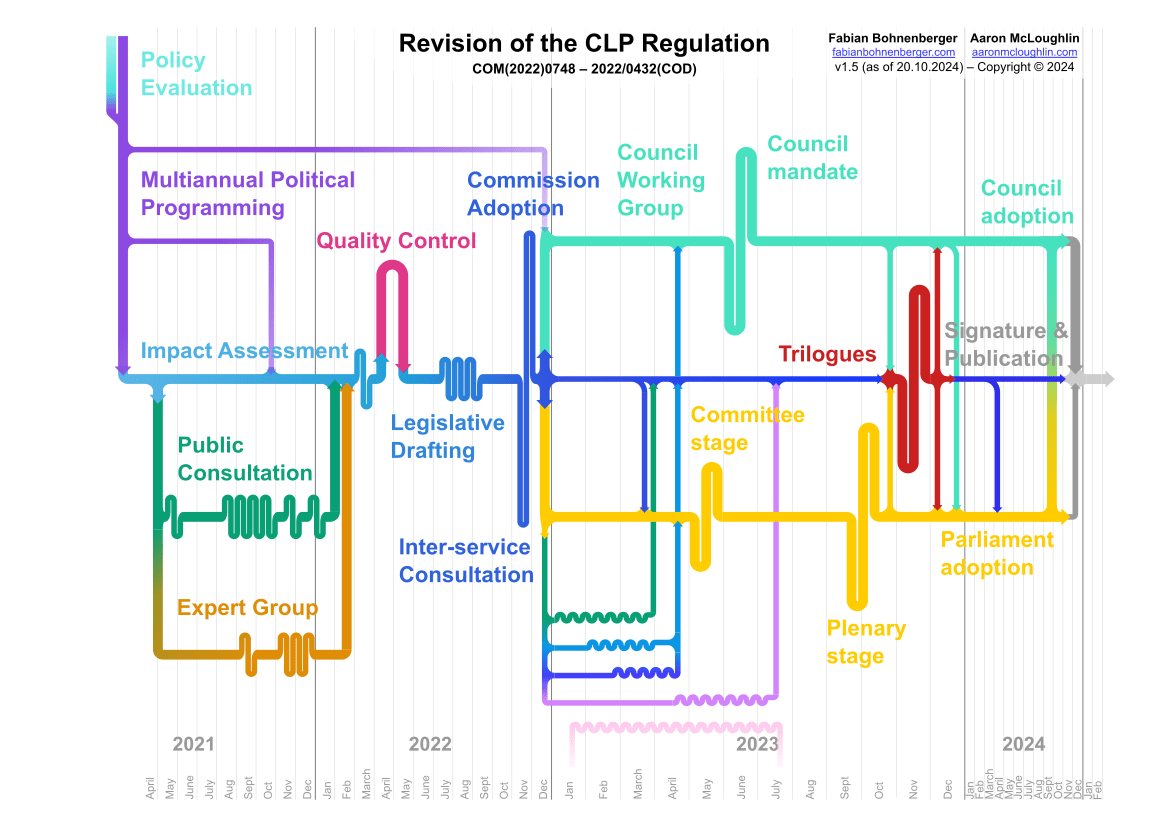
15. Adoption
After the relatively quick trilogue agreement, the Parliament and the Council pass the modified legislative proposal.
Parliament adopts the file at its last plenary in April 2024.
The Council approves the law in October 2024 (after a technical corrigendum had been issued in Parliament). All 27 Member States vote in favour.
16. Signature & Publication
Representatives from the Parliament and the Council sign the new law on 23 October 2024.
As of writing this summary in early November, the final text is currently being prepared for publication and will enter into force 20 days after appearing in the Official Journal.
See the simplified flowchart below to follow these steps. If you want more detail, see my previous post.

 Fabian Bohnenberger
2 responses to “A Detailed Map of EU Law-Making: Explained”
[…] Aaron lists the steps 👉 I introduce the flowchart👉 Step-by-step walkthrough of the […]
LikeLike
[…] 📌 A Detailed Map of EU Law-Making: Explained (link) […]
LikeLike