This series explores the EU’s legislative process using data from the past five years. I recommend you start with part 1 and part 2.
When planning a project, a good rule of thumb is to estimate the time you think you’ll need, then double it. This certainly applies to my blog posts. But it might equally be true for making EU law.
Drafting, negotiating, and adopting EU legislation is far from straightforward. What starts as a simple proposal can get entangled in a web of debates, amendments, and political manoeuvring.
Consider these examples of laws adopted during the last mandate:
- Recovery and Resilience Facility: the economic stimulus package during the pandemic took 266 days from proposal to final law
- Net-Zero Industry Act: 472 days
- Carbon Border Adjustment Mechanism: 671 days
- Artificial Intelligence Act: 1178 days
- Asylum Procedure Regulation: 2870 days (almost 8 years)
These varied timelines highlight not just the complexity of the issues at hand but also the intricate process that determines the speed of a law’s adoption. Let’s dive into the journey that EU laws need to complete.
How do trilogues affect the timeline?
This post focuses on 356 legislative proposals, which represent around two-thirds of all files that moved through the Ordinary Legislative Procedure (OLP) during the last mandate (2019-2024). I consider these laws here because they all required substantial negotiations between the European Parliament, the Council, and the Commission (so-called trilogues).
The fact that trilogues were needed suggests that the legislators disagreed – at least initially – about the need for and contents of the new law, making it necessary to reach a compromise. As a result, only 284 of these laws have been adopted so far. Of these, just 46 were completed within one year of the publication of the Commission proposal. The majority took significantly longer. One-quarter of the completed laws was published within 450 days, half within 712 days, and three-quarters within 1061 days (close to 3 years).
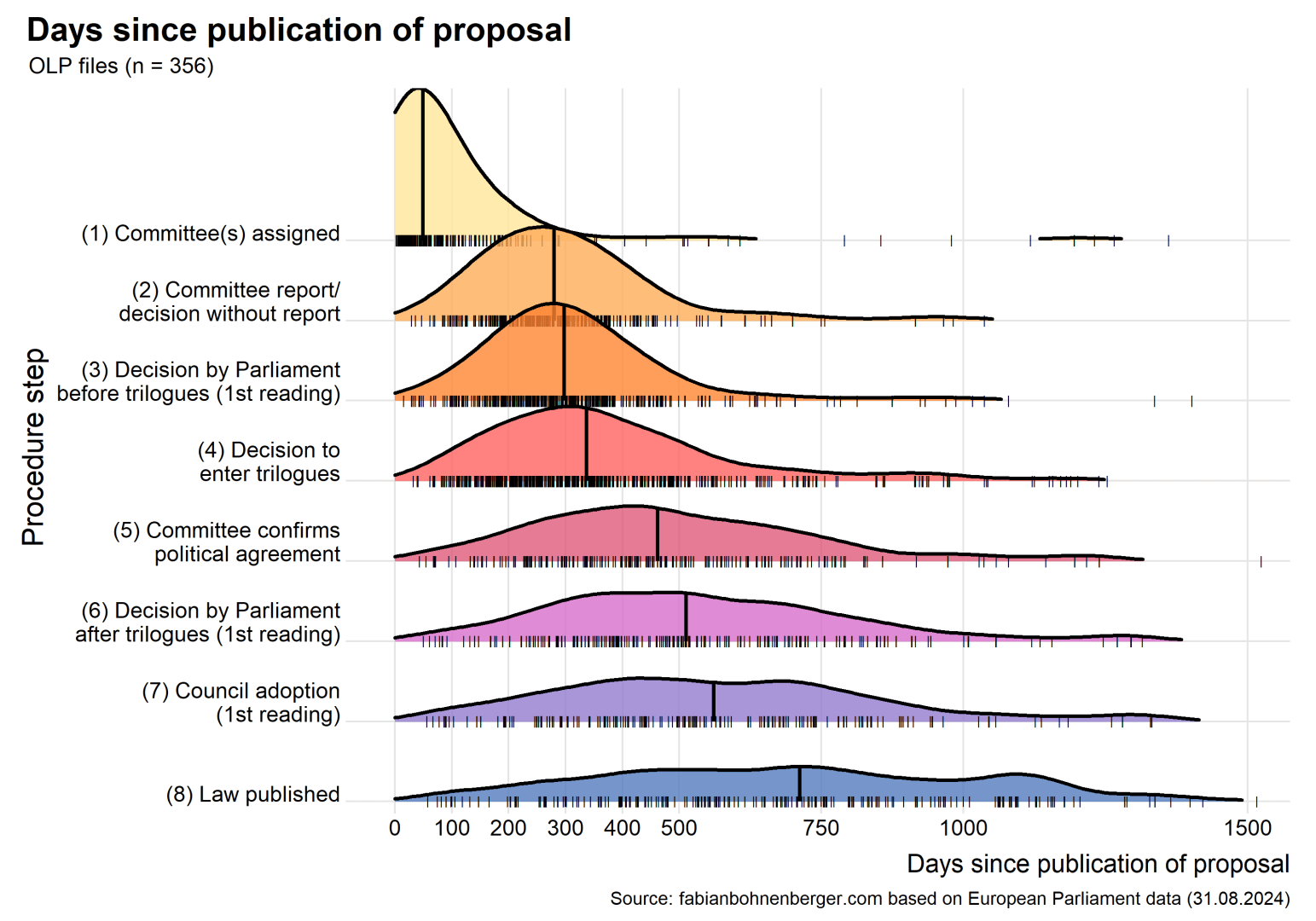
This is how the timeline looks for the 356 files. As before, I plot all steps for every file into one figure. The ridgelines reveal clusters, i.e., where proposals took a similar amount of time to reach a step in the legislative process. I exclude a few extreme values above 1500 days to make it legible.
The black line bisecting each ridge represents the median, meaning half of all observations are below and half are above this value. What looks like barcodes under each ridge shows when each proposal reached this step.
Compare this figure to the one for all files (part 1). You’ll see that the version above looks a lot cleaner – the ridgelines and median values finally line up. This is because we now exclude files that take a slightly different path (part 2). The figure also does not show proposals that remain at steps 1 and 2.
Let’s take a closer look at the steps in the legislative process. I’ll skip stages 1 and 2 here and start where the legislative paths diverge:
Step 3: Decision by Parliament before trilogues
Once a proposal reaches the plenary, Parliament has essentially two options, assuming a majority of its members wants to pass the law:
- Parliament can adopt its first reading position and send it to the Council.
- Alternatively, Parliament can endorse a negotiation position, allowing the relevant committee(s) to enter into trilogues on the text of the final law.
There’s no need to go into detail here, just to say that we will focus on the latter path, which is how the large majority of OLP laws are now adopted. (I cover the first option in part 2.)
For the group of 356 laws, Parliament took a plenary decision approving a negotiation position for trilogues/a decision referring the file back to committee on average within 331 days of the publication of the proposal. The median value is 298 days.
Step 4: Decision to enter trilogues
Once the responsible committee receives a mandate, it can enter into trilogues. This step broadly denotes the committee’s decision to start negotiations, although the coding here varies slightly across the files.
A quarter of these decisions are made within 229 days and half within 337 days of publication of the proposal. Note that median values tend to be more accurate for this data, especially for the later steps, because some extreme values inflate the averages. The average here is 393 days.
Step 5: Committee confirms political agreement
Once negotiators have reached a political agreement in trilogues, the relevant committee confirms that a majority of its members is happy with the compromise.
Half of these committee votes occur within 462 days, about 15 months, from the publication of the proposal. The average is 569 days.
Step 6: Decision by Parliament after trilogues
After confirmation of the trilogue agreement by the committee(s), Parliament adopts its first reading position at a plenary session and sends the result to the Council.
A quarter of these parliamentary votes happen within 358 days and half within 513 days. However, some are made significantly later – see the figure above. A quarter take longer than 714 days.
Step 7: Council adoption
Council can only adopt its position once Parliament has transmitted its views. Because we focus on files with trilogues here, the timeline aligns well – unlike in part 1, where we did not distinguish between laws that take slightly different paths to adoption.
Council makes a decisions on a quarter of the proposals within 373 days, and on half within 561 days. However, a quarter take over 783 days.
Step 8: Law published
As a final step, the law is published in the Official Journal. Half (142 files) entered the lawbooks within 712 days, close to two years after the proposal was published.
This is significantly later than the median across all published OLP files over the last mandate, which is 537 days. We should expect this. The need for trilogues signals disagreements among lawmakers, so files undergoing trilogues should (in aggregate) take longer to complete. (Compare with part 2.)
However, you can again see how dispersed the data is, especially towards the end of the legislative process. This group of OLP files took between 58 and 3675 days from the publication of the legislative proposal to the final law! This massive variation should caution us against relying too much on the median and mean values to describe the process.
| Procedure step | Median (in days) | Mean (in days)** |
| 1. Committee(s) assigned | 49 | 107 |
| 2. Committee report/decision without report | 280 | 317 |
| 3. Decision by Parliament before trilogues (1st reading) | 298 | 331 |
| 4. Decision to enter trilogues | 337 | 393 |
| 5. Committee confirms political agreement | 462 | 569 |
| 6. Decision by Parliament after trilogues (1st reading) | 513 | 612 |
| 7. Council adoption (1st reading)* | 561 | 670 |
| 8. Act published | 712 | 803 |
| Note: Calculated across 356 proposals, for which there is data on trilogues. (*) The Parliament’s data on Council adoption has some gaps. (**) A few extreme values inflate averages. The figure does not show values above 1500 days, but they are included in the calculations. | ||
Don’t stop questioning
I hope you found this data-driven exploration of EU law-making interesting. Although it took a long time and three blog posts, it still feels like we are only scratching the surface. I account for differences in the legislative process, but much of the variation in adoption timelines remains unexplained, especially at the later stages.
To truly understand the varied outcomes and timelines, or even attempt to predict how files move through the process, much more work is necessary. We would need to include factors like political support, policy area, type of legislation, etc. and expand the dataset.
With so much more to explore, I’m sure I will get back to this soon. Let me know what you think and look out for more.


 Fabian Bohnenberger
4 responses to “The Rhythm of EU Law-Making: Trilogues (Part 3)”
[…] Part 3 exploring how trilogues shape the pace of law-making […]
LikeLike
[…] the third post, I focus on the now dominant path to adopt OLP files, which involves detailed negotiations […]
LikeLike
[…] process and build a timeline of its key steps based on a large dataset. (Part 1, Part 2, Part 3, summary & […]
LikeLike
[…] that in perspective, during the last mandate, only a quarter of the laws (that underwent trilogues) made it through in under 450 days – the average was 803 days. Which means the CBAM law was practically […]
LikeLike