EU law-making is complex, and that has its upsides. Don’t get me wrong, I’m not selfishly trying to defend the need for cadres of expensive professionals to clarify opaque laws. What I mean is that the EU’s long-winded process allows legislators and impacted groups to scrutinise the proposed rules and agree workable solutions.
To do this well, stakeholders need to know what laws are being drafted and learn how to navigate the law-making process. This is easier said than done, so let’s explore a legislative journey.
How a law is made
I use the Ecodesign for Sustainable Products Regulation as an example. It was published on 28 June, together with other important acts agreed shortly before the European elections.
The Ecodesign Regulation might not sound like much (other than a bit odd), but it is a big deal. For the EU, it marks a major step towards more environmentally sustainable and “circular” products. This means it will affect almost everyone involved in the lifecycle – design, production, sale, use, repair, recycling, etc. – of a wide range of industrial and consumer products sold in the EU. Many things you touch in your daily life will change (visibly or invisibly) because of it.
How did this law come about? Here is my process map, which highlights some of the key milestones:
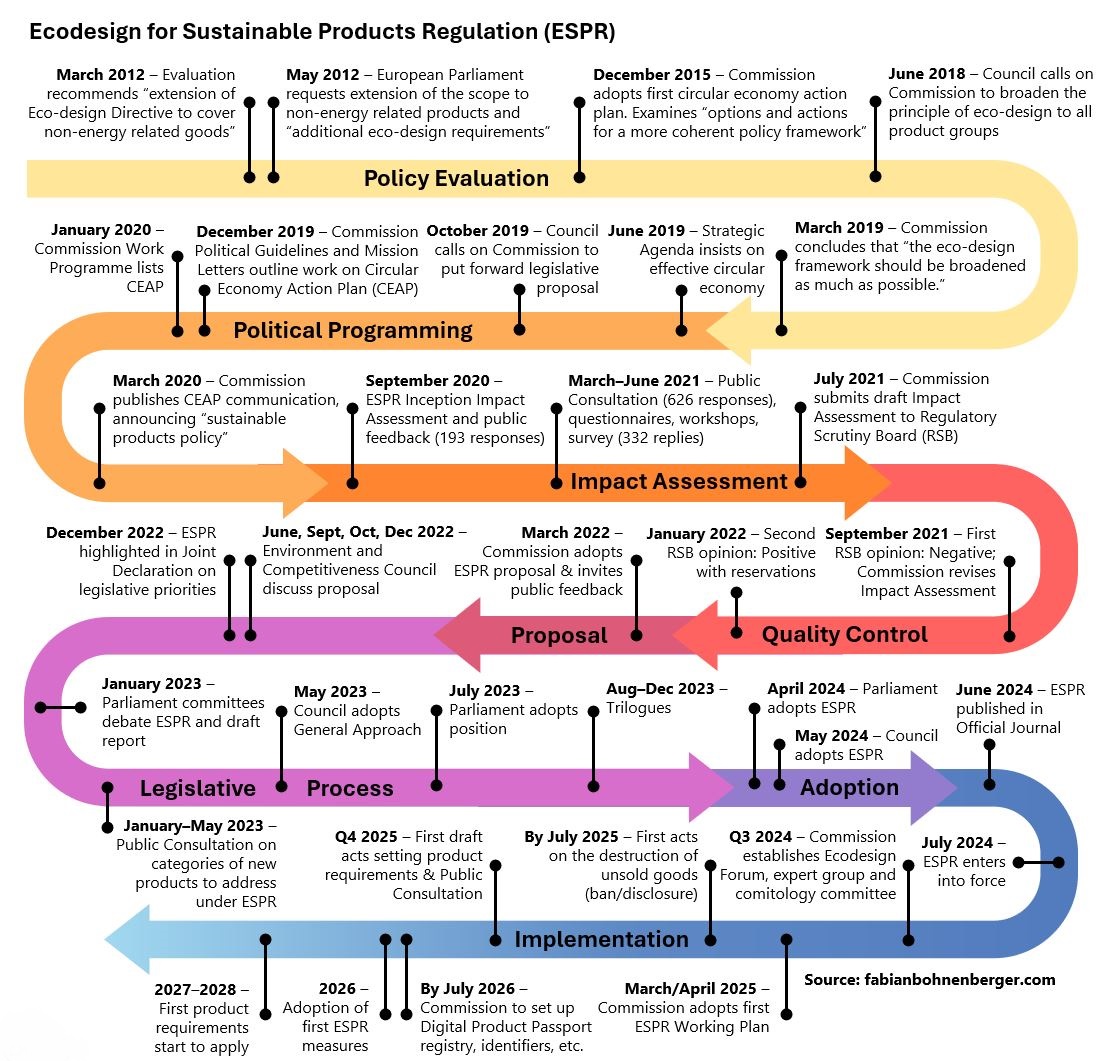
Explaining the entire process and why each step matters would take a book, so let me make just three points and link you to other posts:
1. There was plenty of time to see it coming.
Despite frequent claims to the contrary, EU laws do not materialise out of thin air. The timeline above shows that EU law-making takes many steps. This means that, if you pay attention, you can see new rules coming – often years in advance.
In the case of the Ecodesign law, there were at least ten (10!) years between initial musings about regulating and the Commission proposal. Think about the difference this could have made for affected stakeholders in terms of preparing relevant evidence or establishing yourself as a trusted voice with the regulators.
Granted, not all laws have a decade of lead-in. But put it this way: even if you had started preparing 2-3 years prior to the proposal, your submission would have had more weight with the Commission officials drawing up the rules.
2. Process knowledge is essential.
What do you need to be ahead of the game? At the minimum, a basic understanding of the EU’s law-making process. As the figure shows, this is about much more than the “legislative process”, through which a law is agreed by the Parliament and the Council (Member States).
Once the Commission publishes its proposal, most key decisions have already been made. The Commission has committed to one solution, put it on paper, and presented it to the Parliament and Member States as the best one. It will be hard to unpick the proposal at this stage.
This is why it is so important to engage early. You want to be part of the initial conversations on whether to regulate (labelled “policy evaluation” above) and, if so, in what way (“political programming” and “impact assessment”). This creates opportunities to shape the conversation before everyone commits to a preferred solution. I explain this more here and here.
Of course, a detailed understanding of the process increases your chances to make your voice heard. The figure above shows some of the key milestones, but there is much more to it. My detailed list of the Regulation’s genesis has over 300 steps.
3. This was just the beginning.
Ironically, after all these years, the story of the Ecodesign Regulation has only just begun. The law will enter into force on 18 July and its implementation will be a herculean task involving an array of secondary legislation (delegated and implementing acts) and new expert groups to bring together the knowledge needed to draft new product requirements.
I have sketched out a few indicative steps towards implementation. Some are written into the regulation itself like the deadline for the digital product passport registry (let’s see whether it can be met). Others are based on initial Commission planning, which could change.
So even if this is the first time you are reading about this law, there’s still plenty to be decided that will concern you.

 Fabian Bohnenberger
3 responses to “How to make EU law: The Ecodesign Regulation”
[…] 🛠️ How to make EU law: https://fabianbohnenberger.com/2024/07/08/how-to-make-eu-law-the-ecodesign-regulation/ […]
LikeLike
[…] work builds on previous posts, including my case study of the Ecodesign Regulation (here) and presentation on the Commission’s internal steps to prepare a legislative proposal […]
LikeLike
[…] 🛠️ How to make EU law (link) […]
LikeLike