After the European elections, the EU institutions undergo a process of democratic transition and renewal. The new Parliament meets. It (re)elects EU leaders. Member States and the Commission set new political priorities. Law-making restarts.
All this requires a complex sequence of events. I illustrate the key steps that will be taken over the next months below.
This timeline assumes that Commission President von der Leyen is renominated by the European Council (the Member States) this week, and that the European Parliament then elects her at its constituent sitting in mid-July. If this does not happen, the timeline can slip.
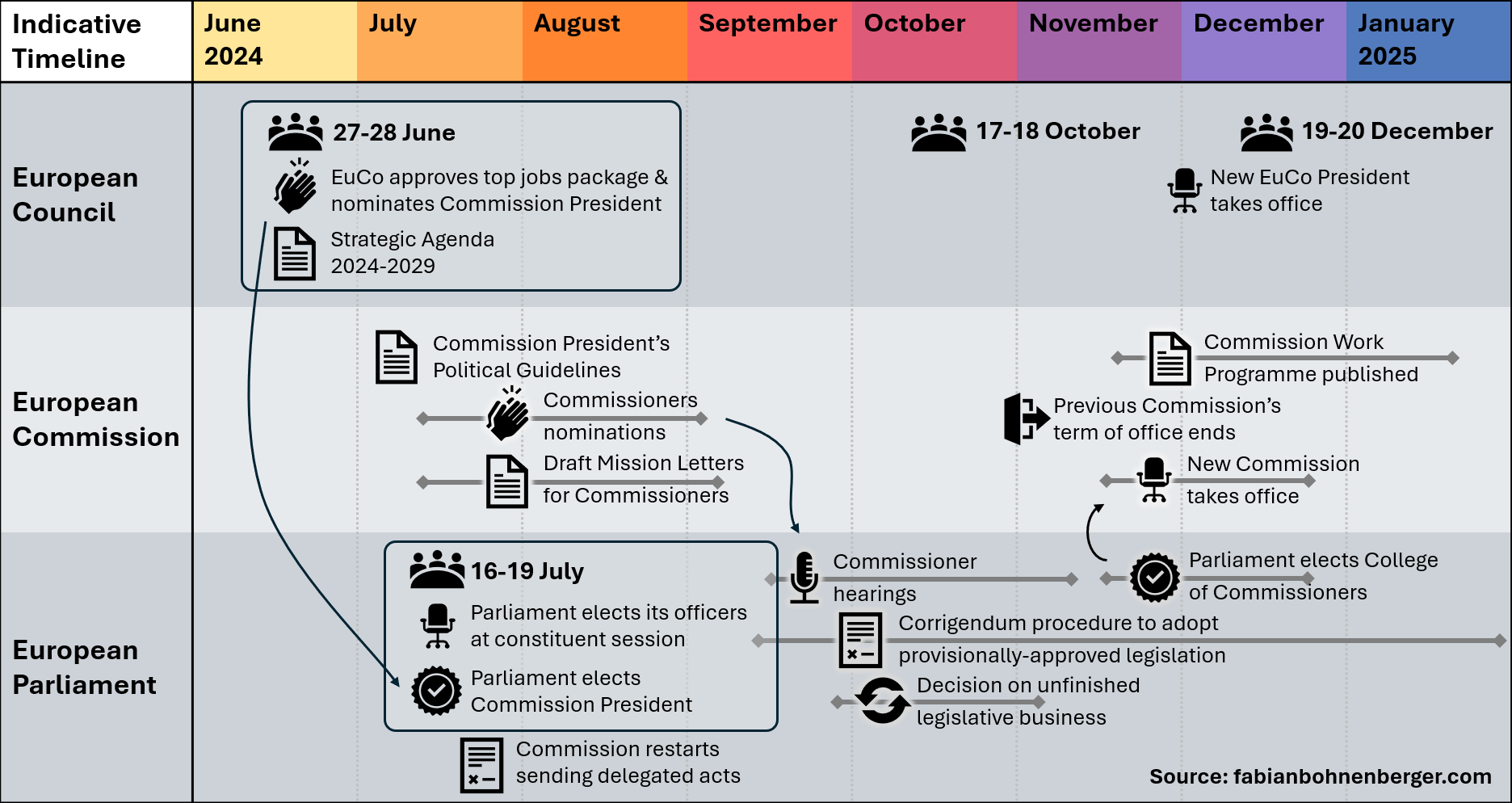
Note that while my focus is on the leadership transition and especially the formation of the new Commission, my timeline also shows a number of events that others rarely include:
I indicate when key documents will become available. In particular:
- European Council Strategic Agenda for 2024-2029 (I explore the leaked drafts here)
- Commission President Political Guidelines (Explained here)
- Commissioner’s Mission letters (outlining their portfolio and priorities)
- the new Commission’s first annual Work Programme (announcing upcoming legislative initiatives, explained here)
I also added key steps to restart the EU’s law-making machinery:
- Once Parliament is reformed, the Commission will restart transmitting delegated acts to it and the Council (the latter is not shown in my figure).
- The Parliament has to make decisions on whether to continue with unfinished legislative business from the last mandate, and communicate these decisions to the Council and the Commission.
- Parliament will start using the corrigendum procedure in the autumn to conclude work on laws that were approved provisionally before the elections.
I hope this simplified timeline helps you navigate the complex post-election period.

 Fabian Bohnenberger
One response to “EU post-election timeline”
[…] up on my earlier post, here is an updated timeline showing the next steps to form a new Commission and restart the […]
LikeLike