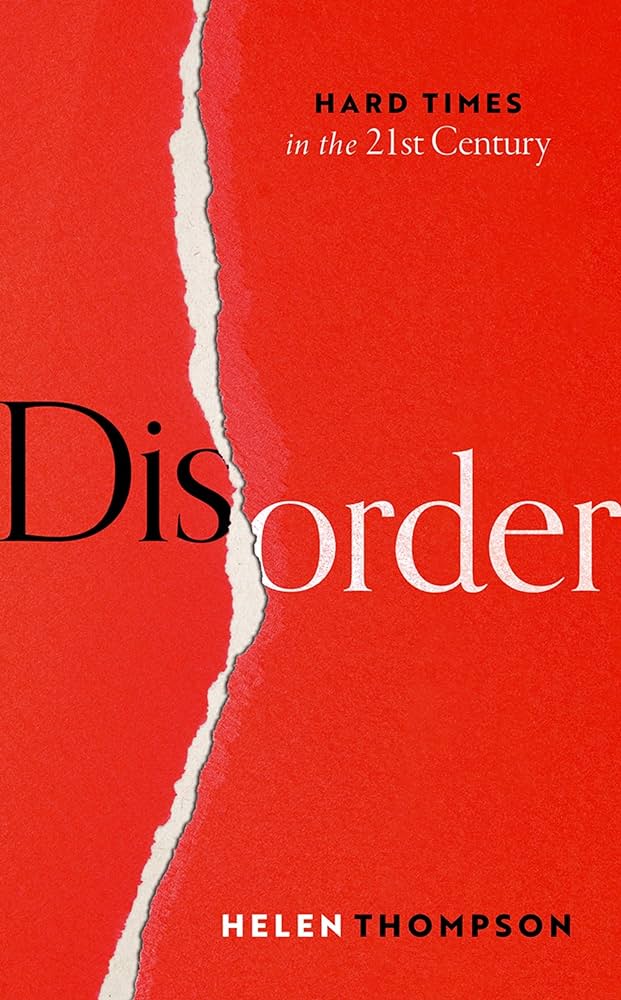
Disorder: Hard Times in the 21st Century by Helen Thompson, Oxford University Press
Disorder weaves together three histories on energy, economy and democracy to present a long-term narrative of economic and political change. Focusing on Europe and the US, Cambridge Professor Thompson argues that many of the economic and geopolitical disruptions we witnessed over recent years have their origins in the 1970s.
The book is as ambitious as it is wide-ranging. Even though it was published in February 2022 (coinciding with Russia’s invasion of Ukraine), recent events show its continued if not enhanced relevance. This confirms Thompson’s skill in identifying the drivers shaping world events. Her attention to energy stands out in particular, which she claims has “largely gone unrecognized” as an important cause of geopolitical and economic disruptions – at least before Russia’s brutal assault. (There are notable exceptions like Yergin’s The Quest or Garavini’s The Rise & Fall of OPEC.)
The energy story delves into the European and from the 1970s also American foreign energy dependence and how it shaped geopolitics and relations with fossil fuel producers and transit countries. It also explores how the shale boom in the US reconfigured energy relations and ends with a prescient warning about the EU’s and particularly Germany’s dependence on Russian gas.
Starting from the breakdown of the Bretton Woods system, the economic narrative traces the successive attempts and failures of European states to stabilise exchange rates, leading up to the creation of the Euro and the fiscal as well as democratic challenges this caused. While some of these storylines are well known, Thompson adds an interesting perspective by highlighting the intractable role of the Eurodollar markets in driving crises and recoveries.
By comparison, the democratic account remains more abstract and explores changing notions of “nationhood”. Ultimately, Thompson argues that increasing international dependencies (on capital markets, trade, energy, supranational governance, common currency, etc.) made democracies less responsive to citizens, fragmenting established party systems and increasing plutocratic tendencies. In addition, “aristocratic excess” (a mix of increasing economic inequality and oligarchic influence of money on elections) would make losers’ consent in democracies increasingly precarious.
Like any guided tour, Thompson can only stop at the highlights. This makes her account “schematic” rather than “forensic”. It also risks it appearing too focused on the structural side of the story. By stressing the broader trends that drive and constrain choices, alternative accounts of the actors actively shaping their world fade into the background. This sometimes relegates governments and others to the role of bit players in a larger story dominated by more amorphous forces like international financial markets, whose composition and interests could have been explored further.
Despite the book’s grand narrative, the focus remains decidedly on Europe and the US. Other regions, even China, appear mainly in relation to them. This does not stop Thompson from making discerning arguments; for example, she highlights how China’s industrial policy has made “green energy now a second source of geopolitical instability” – I just wrote about this here. But it means that her insights apply best to the core Western democracies – this also speaks to the question of whose (dis)order this book is about. Overall, her analysis of Europe is more detailed than that of the US, and her analysis of the UK is deeper than that of the EU and its members.
In a record year for (democratic) elections, faced with a war in Ukraine, a radical reorientation of Europe’s energy supply away from Russia, and increasing (economic) competition from China, Disorder remains well worth your attention.

 Fabian Bohnenberger