Following last week’s post on the need to engage early on upcoming EU legislation, some of you – including my most avid reader (thanks, dad) – asked the logical follow-up question: How do you find out what the Commission is planning?
Clearly, it is key to understand what policy ideas the Commission is (and is not) pursuing if you want to feed in your views early in the process. It is so important, you might say, that many organisations spend a lot of money on representatives in Brussels, where they can keep a close eye on the Commission.
But even if Brussels is far away for you, there are still ways to understand what the EU is up to. In fact, what works in your favour is that the EU is more transparent about its upcoming work than most other (domestic) systems – even though this information rarely makes it into your local news.
From big picture to legislative detail
Let’s first be clear about what you want to know because transparency also means that it’s easy to get lost among the flood of documents the Commission releases every day.
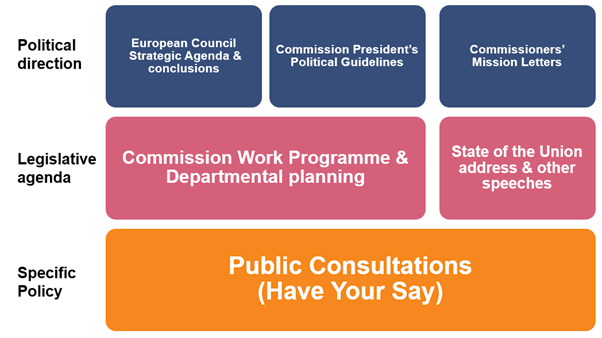
Put simply, you might be looking for information at three different levels: (1) You want to understand the general political priorities of the EU. (2) You might be interested in the EU’s legislative agenda, i.e., what laws are being drafted. (3) You want to know more about and express your views on a specific upcoming policy or piece of legislation.
In each of these areas, a few key sources of information are:
1. Political Direction
If you are interested in the bigger picture, a good starting point is a series of strategic documents that set the political agenda for the EU. These include the European Council’s Strategic Agenda, the Commission President’s Political Guidelines, and individual Commissioners’ Mission Letters at the start of their term, which all describe important goals for a five year period.
Because they align with the Commission’s mandate, the latest set of these documents is from 2019, so they might seem a bit stale by now. But a new batch will be released after the European elections. These won’t get you into the room when the hard political decision are made, but they outline key areas of work for the next Commission and upcoming legislative initiatives. I further explain the Strategic Agenda and Political Guidelines here.
On a more regular basis, European Council conclusions outline specific actions and ambitions.
2. Legislative Agenda
The Commission provides an annual forward-look of its legislative (and non-legislative) plans. The Commission Work Programme (CWP) and its annexes – at least in non-election years – contain a long list of upcoming legislative proposals, together with a rough indication when the Commission intends to adopt/publish the proposals.
For EU professionals, the moment an initiative is published in the CWP is really the final wake-up call – they should know earlier, otherwise what are you paying them for? But if you don’t have the luxury of Brussels-based representation, the CWP still provides an important early-warning function, which offers you some time to make your views heard in Brussels. I briefly look at the last CWP here.
Just before the CWP is published each year, the Commission President in the State of the Union address takes stock of the past year and presents the priorities for the year ahead. This speech links some of the broader political discussions to specific (legislative) initiatives, so is well worth your attention.
Individual departments of the Commission also publish strategic and annual plans to explain how they are going to deliver on specific priorities.
3. Policy Consultations
Now that you are aware of upcoming legislation and want to share your views with the Commission, how do you do that?
The most straightforward (but not necessarily simple) way is to use the tool the Commission has developed for this purpose: the aptly named Have Your Say platform.
The Commission has committed to conduct public consultations on major laws and policies. The Have Your Say website thus provides you with a very long list of ongoing and upcoming work across policy areas. (You can subscribe for updates on topics you are interested in.)
Have Your Say enables you to submit your feedback to the Commission – at least at specific points during the policy development! These time periods vary depending on the type of initiative. Usually there is at least one public consultation while the Commission is preparing its proposal and another after the Commission transmits its proposal to Parliament and Council. But explaining the complex choreography of public consultations needs to wait for another post.
Only a starting point
It’s worth repeating that this is only a fraction – some of the more intelligible – of the available information. There’s plenty more technical detail that you could dive in, assuming you have the energy and fascination for it. And, of course, the tools at your disposal multiply if you are in Brussels.

 Fabian Bohnenberger
4 responses to “How to identify upcoming EU laws”
[…] Commission President Political Guidelines (Explained here) […]
LikeLike
[…] This is why it is so important to engage early. You want to be part of the initial conversations on whether to regulate (labelled “policy evaluation” above) and, if so, in what way (“political programming” and “impact assessment”). This creates opportunities to shape the conversation before everyone commits to a preferred solution. I explain this more here and here. […]
LikeLike
[…] 🔭 How to identify upcoming EU laws: https://fabianbohnenberger.com/2024/02/07/how-to-identify-upcoming-eu-laws/ […]
LikeLike
[…] 🗓️ How to identify upcoming EU laws (link) […]
LikeLike