To influence EU policy successfully, you first need to understand how it is made.
This might sound obvious, but many attempts at shaping EU decision-making still fail because people lack a basic sense of the EU’s policy process. The most common mistake is to engage too late, when most important decisions have already been made.
To help you orient yourself (or whoever you work for), I am sharing below my simple visual aid to explain the policy process to non-experts. My key message is that in order to successfully engage on EU legislation, you need to start as early as possible. This means being prepared and proactive – which sounds a lot easier than it is in practice! But it is unavoidable unless you already have some political heavyweights in your corner.
Put differently, if you think it’s fine to wait for the Commission proposal until you consider what this policy means for you, then this post is for you.
The Commission’s technical process chart
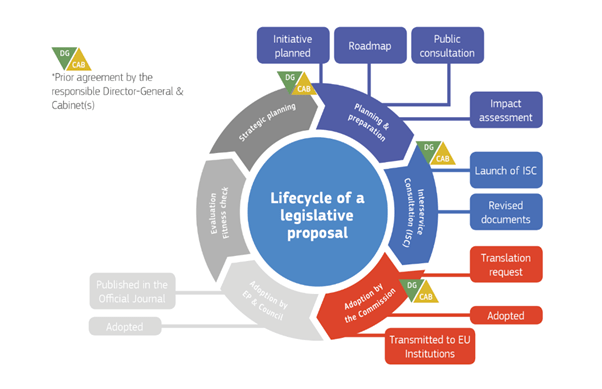
This is how the Commission depicts the EU policy cycle. The figure seems designed for internal use and, as such, is rather unintelligible to non-experts. I won’t explain all of this here, but highlight a few essential elements.
A simplified version for people who care about the outcome
My version is not circular – it does not deal with the whole lifecycle of legislation but focuses on the (usually more pressing) need to understand how new legislation is drawn up.
I start with the planning stage at the top and end with the adoption of the final law at the bottom.
Why is the figure narrowing like this? To illustrate how legislative proposals develop from a vague policy idea into a concrete piece of legislation. As we move down, decisions are made, alternative approaches discarded, compromises negotiated. At the end, only one policy solution is adopted.
Of course, you might want to question whether policy-makers are really this open-minded about the solution when they launch the process, but there are always choices to be made.

The key message I try to communicate with this (very simplified) shape is: If you care about the outcome of a piece of legislation, you need to engage as early as possible in the process. The longer you wait, the more your window of opportunity narrows because the legislation has taken shape without you – which will be very hard to undo.
The moment the Commission first publishes its legislative proposal best illustrates this because it is when many actors first realise that something concerning them is happening.
But at this stage (in my figure this is the midpoint), they are already very late to the party! The Commission has discarded alternative regulatory approaches and committed itself publicly and in writing to one policy solution, and presented it to Parliament and Council as the best one. It should be no surprise that, at this point, you will have a hard time unravelling the proposal.
Sleeping through the impact assessment and public consultation stage is also not advisable, even though it happens a lot. This is a key moment when the Commission is actively asking for your input. If you don’t give it to them when they ask, why should they listen to you later?
Ideally, you should get active even earlier, when initiatives are discussed as part of the Commission’s political planning. Obviously, at this stage we are talking more about general policy goals, rather than concrete regulatory proposals. But the fact that ideas get thrown around at this early stage is precisely what creates opportunities to understand and shape the direction of policy thinking in your area of interest.
There’s obviously much more that could be said about this, but that’s not the point. In fact, brevity – in the form of a handy visual aid to illustrate their challenge/predicament to non-experts – is what this post is about. I hope it proves helpful to you.


 Fabian Bohnenberger
5 responses to “A simple tool to explain the EU policy process – and why you need to engage early”
[…] last week’s post on the need to engage early on upcoming EU legislation, some of you – including my most avid […]
LikeLike
[…] full explanation of the second figure is here. But the key message is the same: A lot of key decisions are made before the Commission adopts its […]
LikeLike
[…] to shape the conversation before everyone commits to a preferred solution. I explain this more here and […]
LikeLike
[…] ⏰ Why you need to engage early in the law-making process: https://fabianbohnenberger.com/2024/01/30/a-simple-tool-to-explain-the-eu-policy-process-and-why-you… […]
LikeLike
[…] ⏰ Why you need to engage early in the law-making process (link) […]
LikeLike