With European elections fast approaching, the EU Institutions have entered the final sprint to adopt unfinished pieces of legislation. The time pressure is most acutely felt in the European Parliament, where Members are engaged in hectic negotiations and votes while also gearing up to campaign for re-election.
But is the current legislative workload higher than usual? Is the current Commission’s ambitious regulatory agenda perhaps putting the legislative machinery into (unsustainable) overdrive?
It’s certainly true that legislators – and EU staff more generally – have worked their way through a large number of highly complex and controversial files over the last months, with some more to come over the next few weeks. However, there are also cyclical highs and lows in parliamentary business – and we have currently reached the natural peak. This legislative business cycle is not new but can easily be identified across the last few parliamentary terms.
Legislative business cycles
There has always been a final rush to complete outstanding legislation before the elections. A key institutional reasons is that unfinished legislative business lapses (I explain here why). Another more personal reason is that MEPs – the majority of which won’t return after the elections – want to get their files approved before the elections.
This institutional dynamic explains both the peak in legislative activity before the election as well as the trough just after it, when new MEPs and Commissioners first need to get their bearings in the EU system.
This great figure by the EP’s civil servants reveals the legislative business cycles, only the arrows are my work:
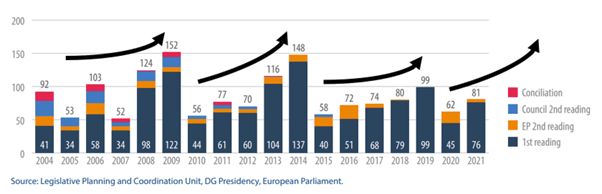
Note this covers only the co-decision/ordinary legislative procedure (OLP), but other parliamentary work also fits this broader pattern. And don’t assume that Parliament has less to do today because some of the older annual counts are very high. The Commission has become better at bundling together legislative changes, meaning Parliament can approach them in a less piecemeal way.
More Trilogues
The figure also reveals another important trend contributing to the frantic activity right now: if you look at the colour coding, you can see how the legislative process has changed. Legislators initially used the co-decision/ordinary legislative procedure more as it was designed, moving methodically through its various stages. But today, almost all legislative acts are adopted at first reading.
Why? Because informal trilogues between the Institutions have been inserted into the procedure. You can argue that this speeds up the negotiations, but it also front-loads the legislative process. Before the elections, this puts more pressure on the responsible MEPs because, again, unfinished legislative business (basically where Parliament has not yet agreed a position) lapses.
The figure below depicts the initial stages of the ordinary legislative procedure and when trilogues take place.

Source: OLP Handbook
Today second reading agreements or conciliations – the later stages – are almost unheard of. The EP’s data above depicts this trend very clearly. You can see that conciliations/third reading agreements already disappeared before 2014, and that second reading agreements vanished shortly thereafter. Only what is known as “early second” reading and first reading agreements remain. So the part of the OLP that I included above is basically all that is used.
This gets us back to Parliament’s current workload because, importantly, the reason why there were still some early second reading agreements in 2020 and 2021 is that these concerned files where the outgoing Parliament had adopted its first reading position prior to the 2019 elections. The Parliament did this to retain progress with a view to continuing negotiations with the Council in the next term!
We might thus expect the current Parliament to follow this example over the coming weeks where trilogues don’t produce quick agreement. This would offer us the opportunity to see a few more early second reading agreements at the start of the next parliamentary term.

 Fabian Bohnenberger
4 responses to “Has the European Parliament always been this busy before the elections?”
[…] continue last week’s theme on the EU’s current workload, I now compare the numbers of legislative files that are still […]
LikeLike
[…] things occasionally go wrong. The large number of files agreed over the last months has led to a (predictable) glut in provisional agreements for the lawyers and translators to […]
LikeLike
[…] Then there is a relatively rare sight: Because we are now so close to the elections, Parliament has adopted positions on 25 files before engaging in talks (“trilogues”) with the Council, its co-legislator. Parliament has partly done this to retain the progress it has made on the file internally – I explain this more here and here. […]
LikeLike
[…] story. This means you need a basic understanding of the legislative procedure (and especially how trilogues work) to accurately interpret the information. In […]
LikeLike