The European Council will meet on 14-15 December, bringing together the heads of state or government of the 27 EU Member States. The leaders face a packed and contested agenda, ranging from agreeing the next steps on EU enlargement to sorting out shortfalls in the EU budget.
This leaves little time for an exchange on another important strand of work, the preparation of the “Strategic Agenda” for the next five years (2024-2029). The process to draw up this high-level political roadmap for the EU has now reached its midpoint. The document needs to be ready by June 2024, in time for the European elections.
What is the Strategic Agenda and why is it important?
The Strategic Agenda is significant not only because it outlines political priorities for the coming years, but also because it speaks to the balance of power between the EU Institutions.
The European Council’s role is to “provide the Union with the necessary impetus for its development and [to] define the general political directions and priorities thereof” (Art. 15(1) TEU). The Strategic Agenda directly expresses this responsibility.
But the fact that the Strategic Agenda is drawn up to coincide with the European elections also shows how the relationship between the EU Institutions has evolved.
European Council conclusions have been used for decades to demand or authorise (Commission) actions. However, Herman van Rompuy, the first full-time President of the European Council, introduced the Strategic Agenda in response to the 2014 European elections, which for the first time used the “Spitzenkandidaten” process to help determine the next President of the European Commission.
The Spitzenkandidaten process meant that the candidate for Commission President, Jean-Claude Juncker, could for the first time claim the support of the electorate and the European Parliament. He no longer had to draw legitimacy primarily from being selected by leaders.
Confronted with this shift in the interinstitutional balance of power, the European Council aimed to reassert its role as the EU agenda-setter and counterbalance against the political authority of a Commission President-“elect” and emboldened Parliament.
Process and priorities
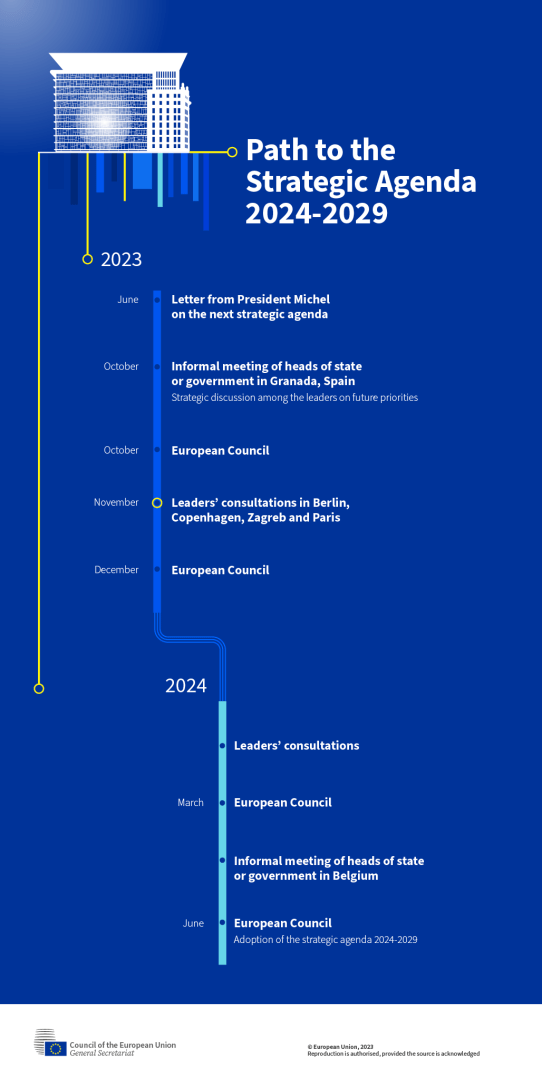
European Council President Charles Michel kicked off the process for the next Strategic Agenda with a letter addressed to European Council members in June 2023.
Leaders then got a chance to discuss strategic priorities at the informal European Council meeting in Granada in October. They set out a broad framework focused on security and defence, resilience and competitiveness, energy, migration, global engagement and enlargement.
To deepen this discussion, Michel invited European Council members to four small group discussions in November. For instance, he met the leaders of France, Portugal, Luxembourg, Estonia and the Netherlands in Paris on 28 November.
Following these dinner conversations and the meeting this week, a draft will be worked up for consideration between April and June next year. This will happen behind the scenes between the General Secretariat and EU Sherpas, the leaders’ top EU advisers.
The Strategic Agenda should be ready for adoption by the June 2024 European Council, when leaders will also haggle about their nominations for the EU top jobs. The (new) Commission President – we do not yet know whether she will have the advantage of being a “Spitzenkandidat” this time around – will then try to apply their own interpretation to the Strategic Agenda.
Process vs. outcome
One final thought: The development process of the Strategic Agenda might arguably be more important than the final, high-level document itself. Existing Agendas remain quite vague to account for the diverging views and need for consensus within the European Council.
However, the process clearly encourages Member State governments and their leaders to do some forward-thinking. Given the many strategic challenges the EU faces, including fundamental questions about enlargement and governance reforms, this added attention and high-level exchange of ideas on the future of the EU is certainly welcome.
The Council General Secretariat provides this useful overview:

 Fabian Bohnenberger
2 responses to “What is the European Council’s Strategic Agenda and why should you care about it?”
[…] Because they align with the Commission’s mandate, the latest set of these documents is from 2019, so they might seem a bit stale by now. But a new batch will be released after the European elections. These won’t get you into the room when the hard political decision are made, but they outline key areas of work for the next Commission and upcoming legislative initiatives. I further explain the Strategic Agenda and Political Guidelines here. […]
LikeLike
[…] The Strategic Agenda is the EU’s high-level political roadmap, defined by the heads of state and government of the Member States. The Agenda is intended to influence the new Commission President, who – once (re)nominated by EU leaders – will set out her Political Guidelines for the next mandate. I explain the origins and significance of the Strategic Agenda here. […]
LikeLike