I am currently extending and analysing my dataset on diplomatic interactions in the World Trade Organization (WTO). This post takes a brief look at the General Council, the highest decision-making body of the WTO. Just as 22 other WTO bodies, all minutes of the General Council are included in my dataset. An earlier post mapped interactions based on a sample of WTO committee minutes.
Here, I am primarily interested in the number of times that each member state is mentioned in the minutes. This is a relatively simple question, but the number of documents that the General Council accumulated since 1995 makes it more challenging. Overall, the council published 214 minutes, which add up to around 7.000 pages or around 5 million words.
So how many countries were mentioned over the last two decades? How often? And did the frequency of mentions change over time?
Overall, my pattern recognition algorithm identified around 75.000 country mentions in the minutes of the General Council between 1995 and 2018. These are divided among 180 countries, which, interestingly, is more than the 164 member states of the WTO and includes countries that are currently trying to join the WTO.
But, of course, the mentions are not divided equally, quite the opposite: As might be expected, some members dominate the discussion. Figure 1 shows the top 30 countries mentioned in the minutes of the General Council between 1995 and 2018.
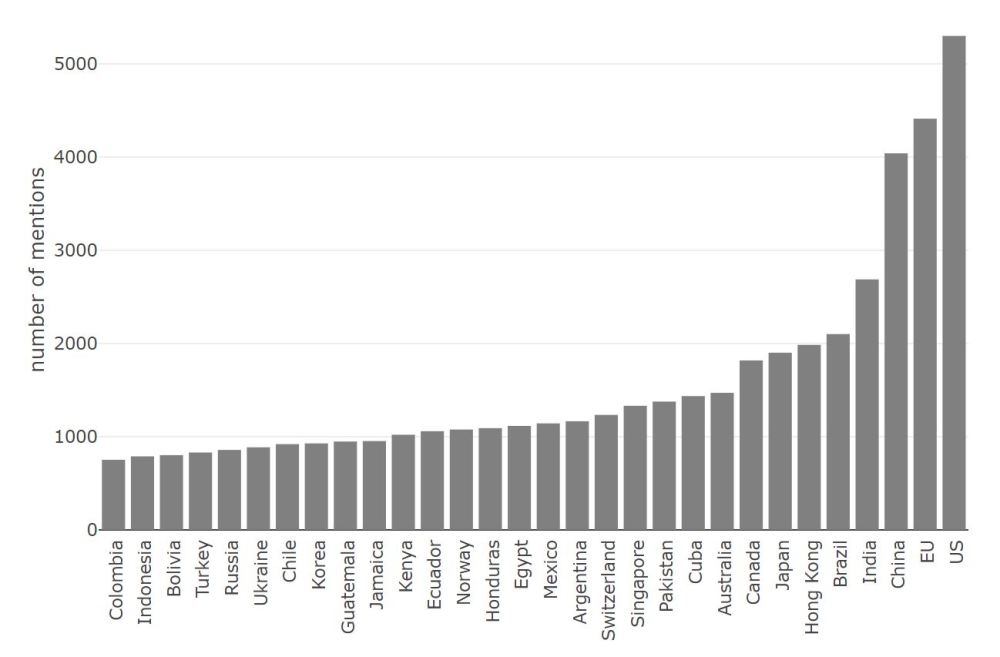
Unsurprisingly, the US and the EU (excluding the EU’s individual members!) take the top spots, but China is not far behind. But considering the high rank of Hong Kong, China (which is a separate member in the WTO), the situation could also be presented differently.
Speaking of the EU members, they are actually mentioned rarely in the General Council. Eastern European states are identified most, which is due to their relatively late accession to the EU.
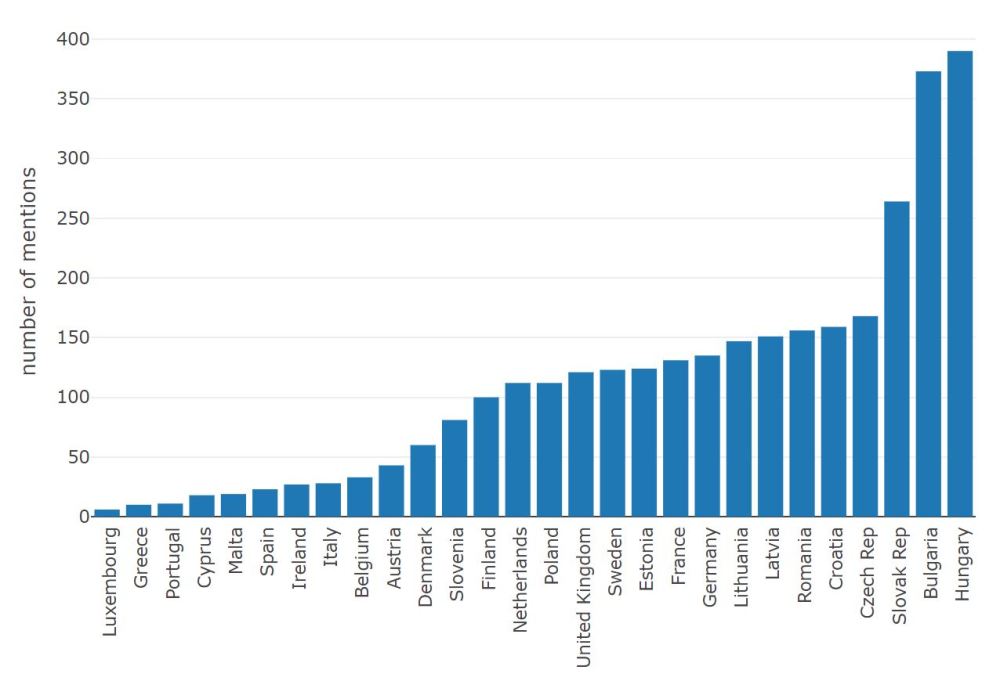
This suggests that the EU not only does most of the talking for its members, but it seems that EU members’ domestic measures are more often identified as European measures by trade partners. Overall, the more general debate in the council might also make it less necessary for individual EU members to raise their voice. This could be different in the more issue-specific work.
Obviously, this only provides a small window into the overall discussions at the WTO. My full dataset covers much more.
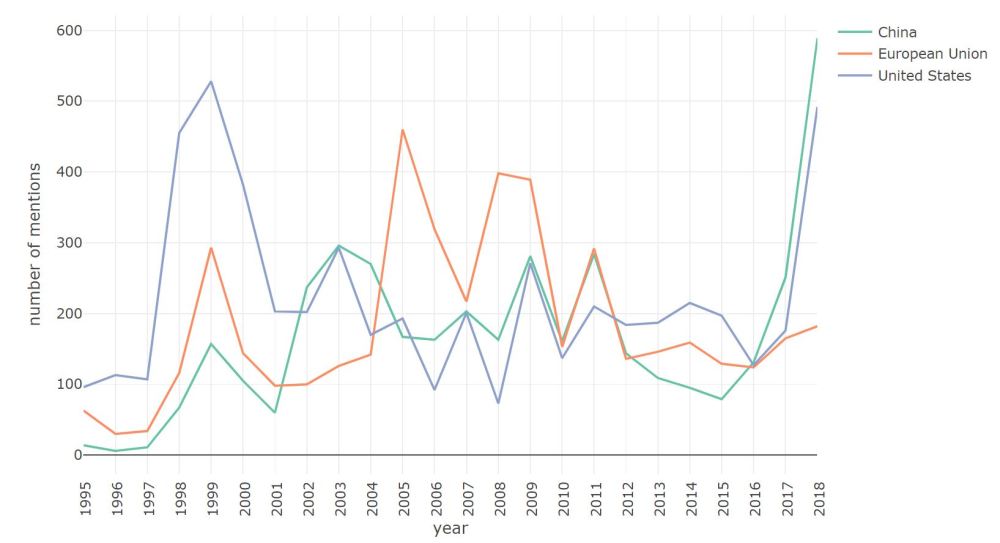
One more interesting finding: The ongoing trade conflict between the US and China and the US position on appointments for the WTO Appellate Body have propelled mentions of the two countries to new heights in 2018. Figure 3 shows the change in country mentions of the US, China and the EU over the years. As you can see, mentions of the US and China skyrocketed in 2018.

 Fabian Bohnenberger